UK Greyhound Betting Odds: The Complete Guide
How fractional and decimal formats work, what the numbers mean, and how to find value before the traps open.
 Available in US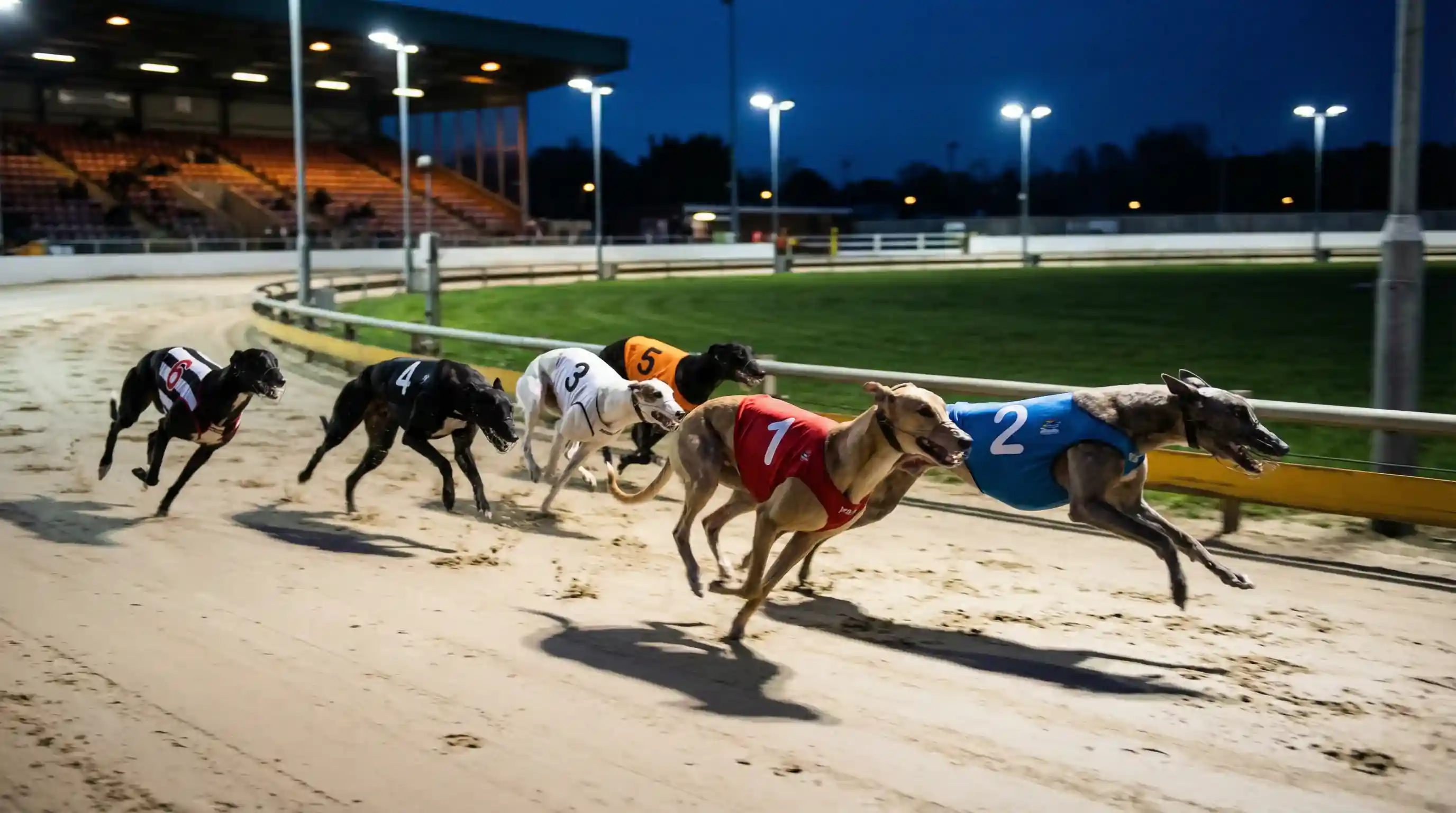
What Makes Greyhound Odds Different — And Why It Matters
Six traps, sixty seconds, and a margin thinner than most punters realise. That is the structural reality of greyhound betting odds in the United Kingdom, and it shapes everything — how prices are formed, how value is found, and how quickly the market moves against you if you hesitate. If you have come from horse racing, you already know the mechanics of a bet. What you may not appreciate is how fundamentally the six-dog field changes the arithmetic underneath it.
In a typical horse race, twelve to sixteen runners spread probability across a wide field. Outsiders drift to 33/1 or beyond. The market is deep and the bookmaker's margin hides easily. Greyhound racing compresses all of that. Six runners. Maximum field. The favourite in a graded race often sits between 5/4 and 3/1, while the outsider rarely exceeds 10/1. The entire odds spectrum fits into a tighter band, and the bookmaker's overround becomes easier to spot if you know where to look.
This compression means that small differences in price carry more weight. A dog drifting from 3/1 to 7/2 in a six-runner field represents a meaningful shift in market confidence. In a twenty-runner horse race, the same movement might be noise. In greyhound racing, it is signal — a compact, fast-moving market where preparation beats impulse.
This guide covers how fractional and decimal formats work, explains the Starting Price mechanism and Best Odds Guaranteed, breaks down every bet type from win singles to combination tricasts, and shows how to read the form data that drives prices. It then moves into how bookmakers build the market, where value hides, and what to check before you commit a pound to the bet slip.
Why six runners change everything
UK greyhound races feature a maximum of six dogs, compared to fields of 10–20+ in horse racing. This compresses the entire odds range: favourites rarely drift beyond 3/1 and outsiders seldom exceed 10/1. The result is a tighter market where the bookmaker's overround is more visible, price movements carry more significance, and the difference between a value bet and a bad price can be a single point on the fraction.
Why six runners change everything
UK greyhound races feature a maximum of six dogs, compared to fields of 10–20+ in horse racing. This compresses the entire odds range: favourites rarely drift beyond 3/1 and outsiders seldom exceed 10/1. The result is a tighter market where the bookmaker's overround is more visible, price movements carry more significance, and the difference between a value bet and a bad price can be a single point on the fraction.
Reading the Numbers: Fractional, Decimal, and What They Tell You
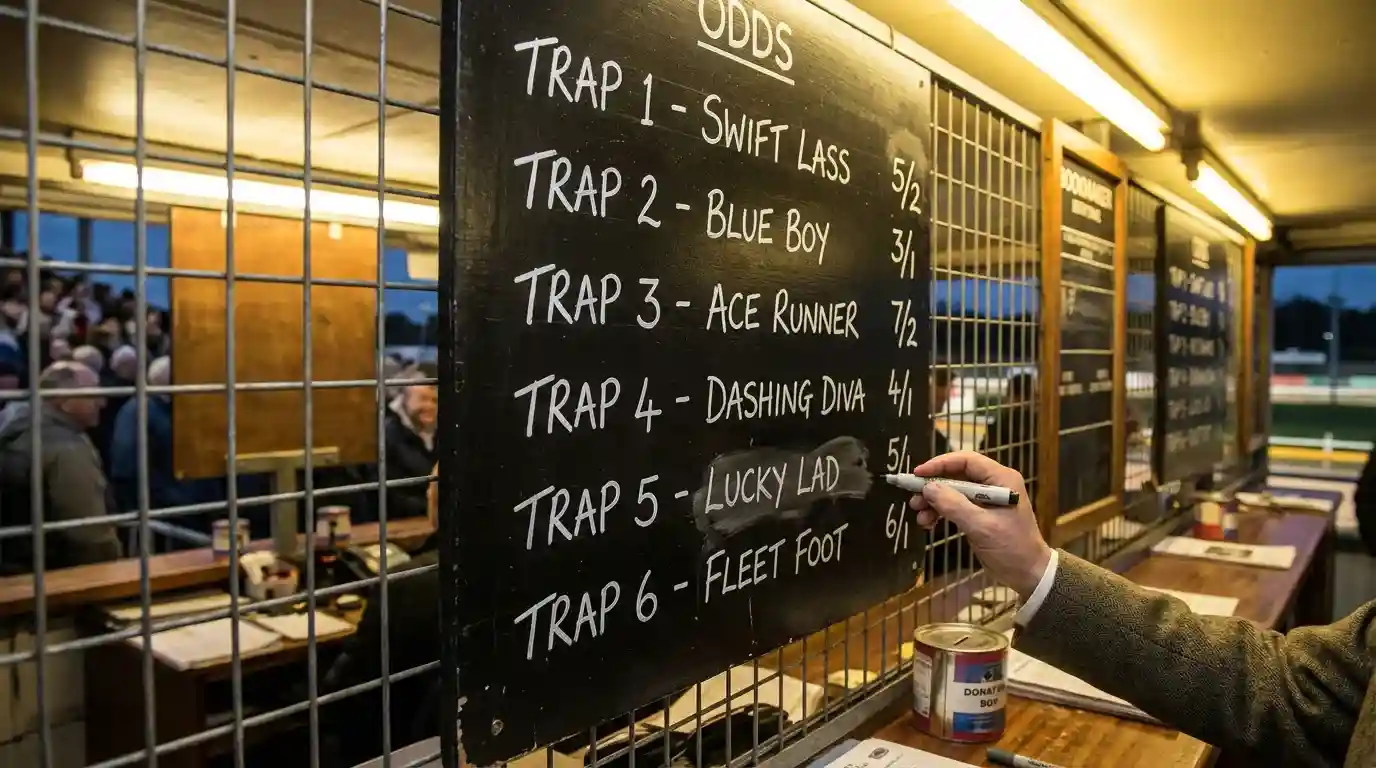
Odds are the market's opinion — your job is to decide if the market is wrong. Before you can do that, you need to read the numbers fluently. UK greyhound racing primarily uses fractional odds, the traditional British format you see on bookmaker boards and in betting shop windows. Exchanges like Betfair use decimal odds, which are standard across European and Australian markets. Both express the same underlying probability in different notation, and switching between them is a skill worth automating in your head.
The critical thing to grasp is that odds are not predictions. They are prices. A dog at 5/1 is not five times less likely to win than the favourite at evens. It is priced at 5/1 because the bookmaker has assessed the market demand, the form data, and the desired profit margin, and set a number that balances the book. The probability implied by 5/1 is 16.7%. Whether the dog's actual chance of winning is higher or lower than that — that is where the punter's edge lives.
Same dog, three formats
Trap 4 — Ballymac Flash
Fractional: 7/2
Decimal: 4.50
Implied probability: 22.2%
A £10 bet at 7/2 returns £45 total (£35 profit + £10 stake). The decimal equivalent: £10 x 4.50 = £45. Same return, same probability, different notation.
How Fractional Odds Work in Greyhound Racing
Fractional odds express your profit relative to your stake. The number on the left (numerator) is what you win; the number on the right (denominator) is what you risk. At 5/1, you win five pounds for every one pound staked. At 7/2, you win seven pounds for every two — or £3.50 per pound. At 4/6, you are odds-on: you risk six pounds to win four, meaning the market considers this dog more likely to win than not.
The common greyhound price points you will encounter most often are evens (1/1), 5/4, 6/4, 7/4, 2/1, 5/2, 3/1, 7/2, 4/1, 5/1, 6/1, 8/1, and 10/1. In a six-runner graded race, the full range from favourite to outsider typically spans from around evens to 8/1 or 10/1. This is narrower than horse racing and means you will encounter odds-on favourites more frequently, particularly in lower grades where one dog clearly outclasses the field.
To calculate your return from fractional odds: multiply your stake by the fraction, then add your stake back. A £5 bet at 7/2: (7 divided by 2) times 5 = £17.50 profit, plus £5 stake = £22.50 total return. For odds-on prices, the profit is smaller than the stake. A £10 bet at 4/6: (4 divided by 6) times 10 = £6.67 profit, plus £10 stake = £16.67 total.
Converting fractional odds to implied probability is straightforward: divide the denominator by the sum of both numbers, then multiply by 100. For 3/1: 1 divided by (3 + 1) = 0.25, or 25%. For 5/2: 2 divided by (5 + 2) = 0.286, or 28.6%. This conversion is essential because it lets you compare the bookmaker's assessment with your own. If you believe a dog has a 30% chance of winning but the odds imply only 20%, you have found a potential value bet. If the odds imply 35%, the market is telling you something your analysis may have missed.
Decimal Odds and Exchange Pricing
Decimal odds include your stake in the number, which makes comparison across bookmakers instant. A price of 4.50 means you receive £4.50 for every £1 bet — including the pound you put in. Your profit is therefore £3.50. This is identical to 7/2 in fractional terms, but the decimal format makes side-by-side comparison faster because you do not need to perform mental division. When you are scanning five bookmaker apps sixty seconds before the traps open, speed matters.
The conversion formula is simple. Take your fractional odds, divide the numerator by the denominator, and add 1. So 5/1 becomes (5 divided by 1) + 1 = 6.00. 7/4 becomes (7 divided by 4) + 1 = 2.75. Evens is 2.00. Odds-on at 4/6 becomes (4 divided by 6) + 1 = 1.67. To go the other way — decimal to fractional — subtract 1 and express the result as a fraction. 3.50 becomes 2.50, which is 5/2.
Betting exchanges favour decimal odds because they allow finer price increments. On Betfair, you can back a dog at 4.4 or 4.5 — a distinction that fractional notation cannot easily express. This precision matters for exchange users who are matching bets against other punters rather than accepting a bookmaker's fixed price. It also matters when you are comparing the exchange price to a bookmaker's fractional offering. If a bookmaker offers 7/2 (4.50) and the exchange has the same dog available to back at 4.8, the exchange is offering better value — even after the commission deduction, which typically sits between 2% and 5% on winnings.
Overround — the margin built into a set of odds that ensures the bookmaker profits regardless of the result. If you convert every dog's odds to implied probability and add them together, the total will exceed 100%. The amount above 100% is the overround. A typical UK greyhound race carries an overround between 115% and 125%, meaning the bookmaker has a theoretical edge of 15–25% across the field.
Same dog, three formats
Trap 4 — Ballymac Flash
Fractional: 7/2
Decimal: 4.50
Implied probability: 22.2%
A £10 bet at 7/2 returns £45 total (£35 profit + £10 stake). The decimal equivalent: £10 x 4.50 = £45. Same return, same probability, different notation.
Overround — the margin built into a set of odds that ensures the bookmaker profits regardless of the result. If you convert every dog's odds to implied probability and add them together, the total will exceed 100%. The amount above 100% is the overround. A typical UK greyhound race carries an overround between 115% and 125%, meaning the bookmaker has a theoretical edge of 15–25% across the field.
Starting Price, Board Price, and When to Take the Odds
The price you see at 10am is not the price you will get at 7:42pm — unless you lock it in. This is the central tension in greyhound betting, and it catches more punters out than any form misread or trap miscalculation. Understanding the difference between a board price, a fixed price, and the Starting Price is essential to knowing when you are getting value and when the market has already moved past you.
The board price is the initial set of odds published for a race, usually appearing several hours before the off. These prices reflect the bookmaker's assessment of form, trap draw, and expected market behaviour. As money comes in — and as the on-course market develops — prices shift. A dog opening at 4/1 might shorten to 3/1 by race time if it attracts heavy support. The Starting Price is the official price returned at the moment the traps open, determined by independent SP reporters who assess the on-course bookmakers' boards immediately before the off.
The decision between taking a fixed price early and waiting for SP is situational. If your form analysis tells you a dog is value at the morning price of 5/1 and you expect the market to shorten, take the price. If you believe a dog is over-bet at 2/1 and might drift, waiting for SP could deliver a better return. Best Odds Guaranteed — offered by most major UK bookmakers on BAGS and BEGS meetings — eliminates part of this dilemma. With BOG, if you take a fixed price and the SP turns out higher, you are paid at the better price. If the SP is lower, you keep the price you took. It is a genuine edge when it applies.
However, BOG does not cover all meetings. It typically applies to afternoon BAGS cards and evening BEGS fixtures at licensed tracks. Open race nights, category events, and major competitions like the English Greyhound Derby may not qualify. As of 2026, most major UK bookmakers offer BOG on standard BAGS greyhound meetings, but the specific terms vary between operators and can change between racing seasons. Always check the terms before assuming coverage, because placing a bet at a fixed price on a non-BOG meeting locks you in with no safety net if the SP moves in your favour.
BOG coverage warning
Best Odds Guaranteed typically covers BAGS and BEGS meetings only. Open race nights, feature events, and ante-post markets are often excluded. Check your bookmaker's specific terms before each meeting — coverage can vary by operator and by card.
BOG coverage warning
Best Odds Guaranteed typically covers BAGS and BEGS meetings only. Open race nights, feature events, and ante-post markets are often excluded. Check your bookmaker's specific terms before each meeting — coverage can vary by operator and by card.
Every Greyhound Bet Type, Ranked by Risk and Reward
Win bets pay the bills. Everything else is for punters who have earned the right to complicate things. That is not snobbery — it is risk management. The greyhound betting market offers a range of wager types from the simple to the exotic, and each one carries a different risk-reward profile that suits different situations, different bankrolls, and different levels of confidence in your selection. Understanding all of them gives you options. Using the right one at the right time is what separates the methodical bettor from the recreational one.
The hierarchy runs from low-risk, low-return bets (win, place) through moderate-risk options (each-way, forecast) to high-risk, high-return territory (tricast, accumulator). The six-runner field makes positional bets — forecasts and tricasts — more approachable than in horse racing, because the number of possible finishing combinations is dramatically smaller. In a six-dog race, there are 30 possible forecast outcomes (first and second in order) and 120 possible tricast outcomes. In a twelve-runner horse race, those numbers jump to 132 and 1,320 respectively. The compressed field is your advantage if you choose to use it.
Forecast
Predict first and second.
30 possible outcomes in a 6-dog race.
Straight forecast: 1 unit stake.
Typical dividend: £15–£80 from a £1 stake.
Lower risk than tricast, moderate returns.
Tricast
Predict first, second, and third.
120 possible outcomes in a 6-dog race.
Straight tricast: 1 unit stake.
Typical dividend: £50–£500+ from a £1 stake.
Higher risk, potentially significant returns.
Win, Place, and Each-Way Bets on Greyhounds
A win bet is the cleanest wager in greyhound racing. You pick a dog, it wins, you get paid at the agreed odds. If it finishes second or worse, your stake is lost. In a six-runner field, the random probability of any single dog winning is 16.7%. Favourites in graded races succeed roughly a third of the time, which means they fail more often than they win. That baseline should inform every win bet you place.
A place bet pays out if your selection finishes first or second. In UK greyhound racing with six runners, standard place terms cover the top two positions. The place odds are typically one quarter of the win odds: a dog at 4/1 to win pays 1/1 (evens) for a place. Place betting reduces volatility but also compresses returns. You are trading upside for a broader target, and in a six-runner field that target is still only two spots wide.
Each-way is two bets in one — a win bet and a place bet, both at the same stake. A £5 each-way wager costs £10 total: £5 on the dog to win at full odds and £5 on the dog to place at one quarter of the win odds. If the dog wins, both parts pay out. If it finishes second, only the place part pays. If it finishes third or worse, you lose the entire £10. Each-way makes mathematical sense primarily on longer-priced selections. On a dog at 6/1, the place part pays 6/4 — a meaningful return for a second-place finish. On a dog at 2/1, the place part pays only 1/2, and the each-way bet becomes an expensive way to collect a small consolation prize.
Forecast and Tricast Bets: Picking the Order
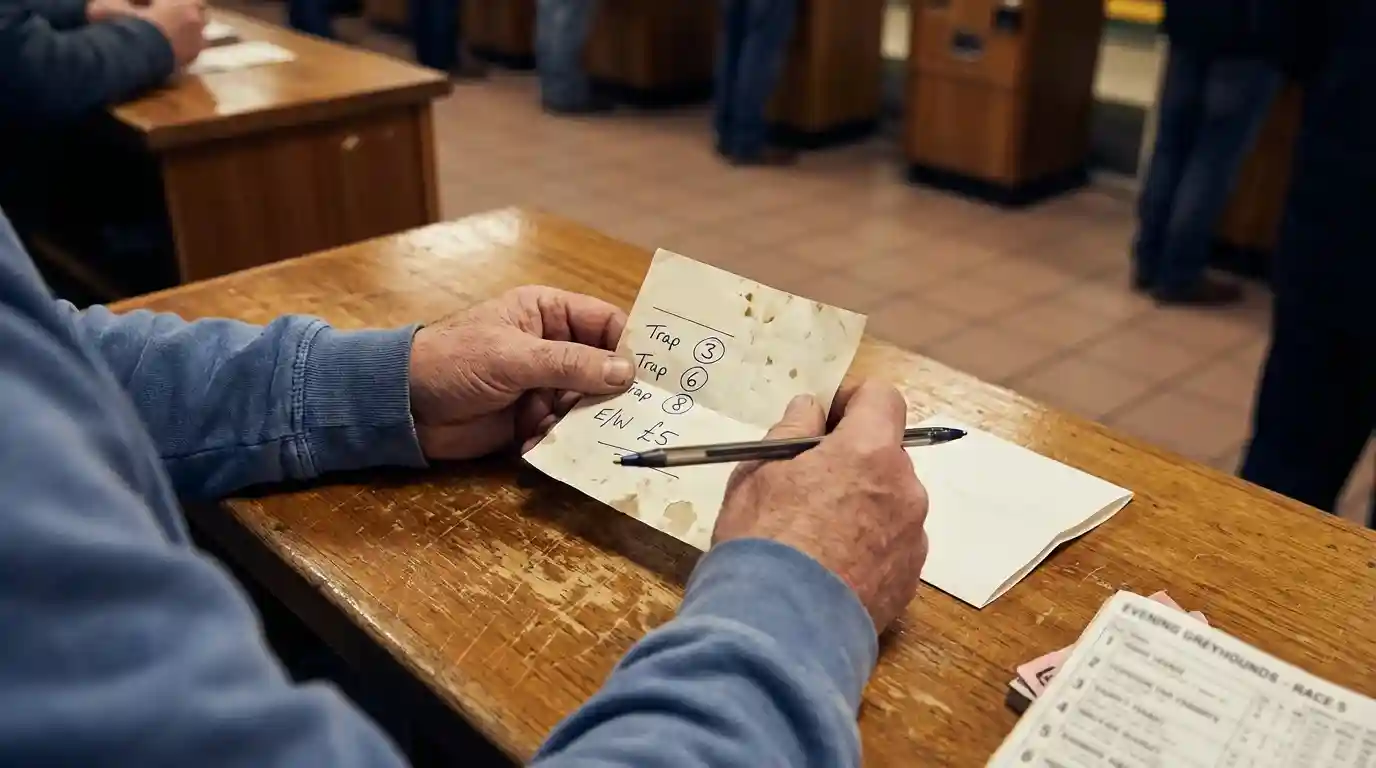
A straight forecast requires you to name the first and second finisher in the exact order. Get both right and the payout is determined by the declared Computer Straight Forecast dividend — a pool-based calculation that reflects the number of possible combinations and the actual result. Forecast dividends in greyhound racing are not fixed by the bookmaker; they are calculated after the race using a formula based on the Starting Prices of the first two finishers. Typical CSF returns from a £1 stake range from around £15 for a predictable result to over £100 when both places are filled by longer-priced dogs.
A reverse forecast covers both possible orderings of your two selections. If you pick dog A and dog B, the reverse forecast pays out if A finishes first and B second, or if B finishes first and A second. It costs two units — because it is effectively two straight forecasts. This halves the risk of getting the order wrong, but doubles the outlay. A combination forecast extends the concept: pick three or more dogs and cover every possible first-and-second pairing. Three selections generate six permutations at six times the unit stake; four selections produce twelve permutations.
Tricasts demand first, second, and third in the correct order. The straight tricast is the hardest standard bet to land, but the six-dog field makes it more achievable than in larger horse racing fields. A combination tricast with four selections covers 24 permutations. With all six dogs in the field, a full combination tricast costs 120 units — £120 at £1 stakes — but guarantees the tricast is covered regardless of the finishing order. The potential four-figure returns on a favourable result can justify the outlay for punters who have narrowed the field through form analysis but cannot separate the top three with confidence.
Accumulators and Multiple Bets Across Races
Accumulators link two or more selections across different races into a single bet. All selections must win for the accumulator to pay out. The returns compound: a four-fold accumulator at average greyhound odds can return twenty to thirty times the stake. The probability of all four winning, however, typically sits below 5%. Each additional leg multiplies the potential return — and multiplies the chance of failure. One losing selection out of four means zero return on the entire wager.
Doubles and trebles are the most practical forms of multiple for serious greyhound bettors. They keep the compounding manageable and the hit rate within realistic bounds. Beyond three or four selections, accumulators enter lottery territory — exciting to land but statistically hostile over any meaningful sample size. Most bookmakers offer acca insurance or acca boost promotions on greyhound multiples, refunding the stake as a free bet if one leg lets you down or enhancing the odds by a percentage. These promotions have value, but they do not change the fundamental mathematics of compounding probabilities against you.
Full-cover bets — patent, trixie, yankee, lucky 15, and their variants — package singles, doubles, trebles, and the accumulator together. They cost more but offer partial returns even when not all selections win. For greyhound racing, where form upsets are common in short fields, a trixie on three strong selections can return a profit even if one dog finishes second rather than first. The cost is higher. The variance is lower. For punters with a genuine edge in multiple races on the same card, full-cover bets represent a more disciplined approach to multi-race betting than the raw accumulator.
Forecast
Predict first and second.
30 possible outcomes in a 6-dog race.
Straight forecast: 1 unit stake.
Typical dividend: £15–£80 from a £1 stake.
Lower risk than tricast, moderate returns.
Tricast
Predict first, second, and third.
120 possible outcomes in a 6-dog race.
Straight tricast: 1 unit stake.
Typical dividend: £50–£500+ from a £1 stake.
Higher risk, potentially significant returns.
Reading Greyhound Form: The Data That Shapes the Odds
Every number on that race card is a clue — if you know what to look for. The odds you see on screen are not drawn from thin air. They are built on form data: finishing positions, trap draws, sectional times, weight, grade, trainer record, and running style. The bookmaker's price for each dog is a synthesis of this data, filtered through market demand. The punter who can read the same data and reach a different conclusion — a better conclusion — has found value. The punter who cannot read it at all is betting blind.
Form reading in greyhound racing is both simpler and more compressed than in horse racing. Simpler because the fields are smaller and the data points fewer. More compressed because greyhound meetings turn over fast — dogs might race every four to seven days, generating new form continuously. A dog's last three runs are more relevant than its best time from six months ago. Recent form in this grade, at this distance, at this track is the gold standard. Anything older is context, not currency.
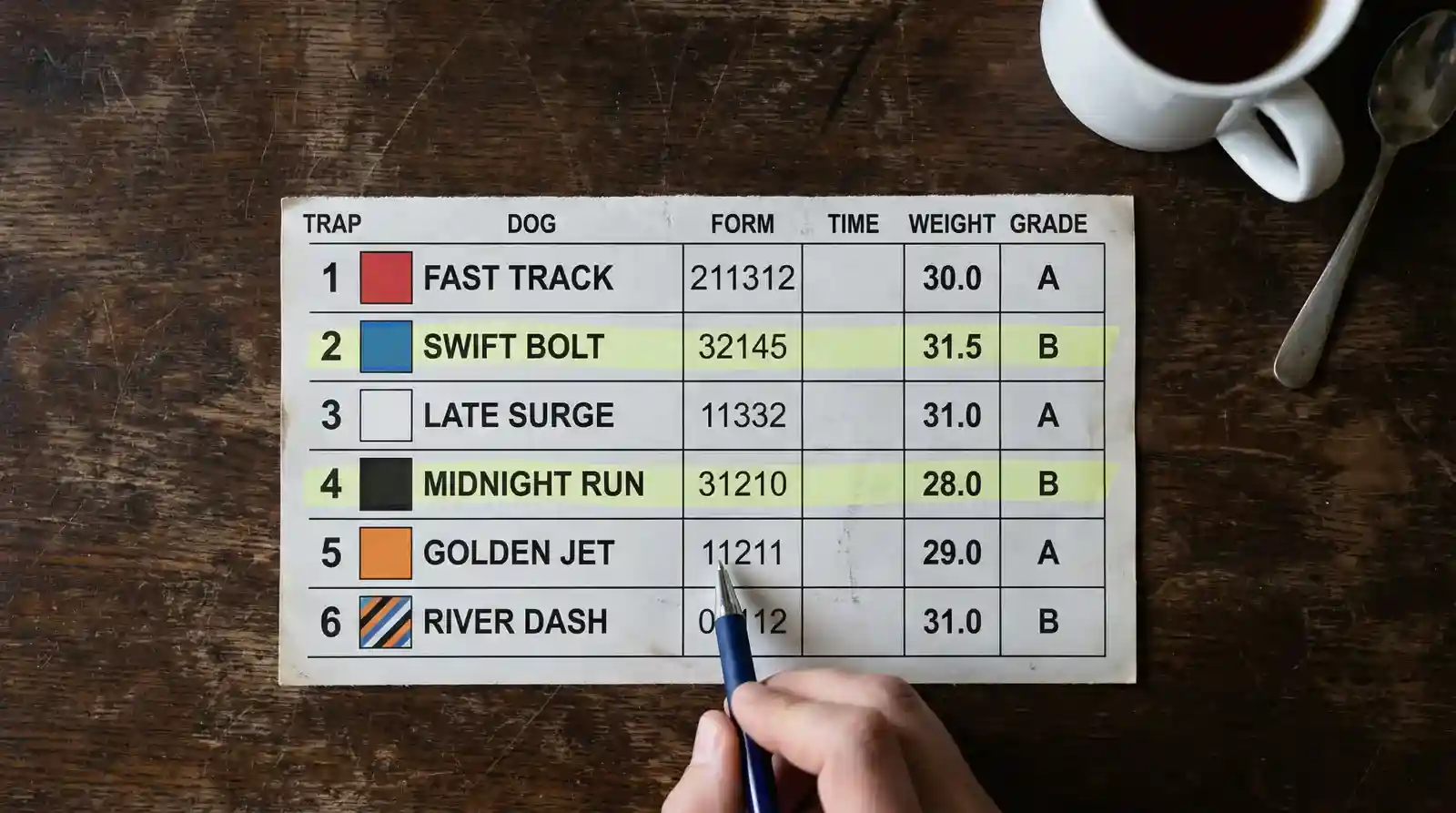
The race card is your primary analytical tool, and most modern betting apps display it with enough detail to make an informed decision without leaving the screen. The key is knowing which columns matter most and which are decoration. Trap number and form figures sit at the core. Sectional times add depth. Trainer record and weight change provide supporting evidence. Race comments from analysts can save time — but they cannot replace your own reading of the raw numbers.
The favourite wins roughly 35% of UK graded greyhound races — meaning outsiders win nearly two-thirds of the time. This single statistic explains why studying form beyond the favourite is where the real value lives.
What Every Column on the Race Card Means
The trap number sits at the far left of the race card and runs from 1 to 6. Each number corresponds to a jacket colour: trap 1 is red, trap 2 is blue, trap 3 is white, trap 4 is black, trap 5 is orange, and trap 6 wears black and white stripes. The trap is not just an identifier — it is the dog's starting position, and at certain tracks it has a measurable impact on race outcome. More on that shortly.
The form string is a sequence of recent finishing positions, typically the last six runs, reading from left to right with the most recent result on the right. A string of 2-1-1-3-1-2 tells you the dog has been consistently competitive, winning three of its last six and never finishing worse than third. A string of 5-4-6-3-5-4 suggests a dog out of form or consistently outclassed at its current grade. Letters in the form string carry specific meaning: D indicates disqualification, F means fell, and a dash or blank space means the dog did not run.
Best time at the distance is shown in seconds and hundredths — for instance, 24.12 for a 400-metre sprint. This column represents the dog's fastest recorded run at the race distance. It provides a benchmark but must be interpreted cautiously: a best time recorded three months ago on fast going is not directly comparable to current form on slower ground. Calculated time adjusts for going conditions and offers a more reliable comparison, though not all race cards display it.
Grade tells you the class of race: A1 is the highest graded level at a given track, descending through A2, A3, and so on. Open races sit above the grading structure entirely, featuring the best dogs at the circuit. When a dog wins at a grade, it typically moves up; when it finishes consistently poorly, it drops. A dog recently promoted from A4 to A3 may face stiffer competition than its form suggests. A dog dropping from A2 to A3 after a string of losses might be finding its level — or might be about to bounce back. Grade movement is one of the most underrated form indicators in greyhound racing.
Trap Draw: Why Starting Position Changes Everything
In a six-runner race on a tight oval track, where a dog starts has a measurable impact on where it finishes. Trap 1 sits closest to the inside rail; trap 6 is widest. At a track like Romford, where the run to the first bend is short and the bends are sharp, inside traps produce significantly more winners than the statistical average of 16.7% per trap. At bigger, more galloping tracks with sweeping bends, the bias flattens — but it does not disappear entirely.
The bias exists because of geometry, not superstition. A dog in trap 1 has the shortest path to the first bend and can establish a rail position immediately. A dog in trap 6 covers more ground and risks being carried wide by dogs cutting in from the middle traps. Running style compounds the effect: a confirmed railer drawn in trap 5 faces a structural disadvantage because it needs to cross traffic to find its preferred line. A wide runner drawn in trap 1 may be equally uncomfortable.
Checking trap statistics for the specific track before every bet is a thirty-second task that can fundamentally change your assessment of a race. Resources like Greyhound Stats and Timeform publish track-specific trap data showing win percentages by trap at each distance. If trap 1 at Romford wins 22% of 400-metre races and the dog drawn there is priced at 4/1 (implied probability 20%), the trap data alone suggests the market may be slightly undervaluing that draw. Conversely, a dog in trap 6 at the same track priced at 3/1 may be overvalued relative to the historical strike rate. None of this guarantees a result, but it adds a layer of analysis that most casual punters skip entirely.
The favourite wins roughly 35% of UK graded greyhound races — meaning outsiders win nearly two-thirds of the time. This single statistic explains why studying form beyond the favourite is where the real value lives.
How Bookmakers Build the Greyhound Market
The odds are not a prediction — they are a price designed to balance the book. Understanding how that price is assembled gives you an edge that most punters never acquire, because most punters accept odds as given rather than examining them as manufactured products. Every set of greyhound odds starts with a raw assessment and ends with a commercial calculation, and the gap between those two things is where the bookmaker's profit lives.
The process begins with the bookmaker's traders assessing the race card: recent form, trap draw, grade context, trainer record, and known running style. From this, they assign an initial probability to each dog and convert it to odds. At this stage, the prices roughly reflect the race's likely outcome — but they do not add up to exactly 100%. The bookmaker inflates the total to build in a margin. This is the overround, and it is the bookmaker's structural advantage.
A typical six-runner greyhound race carries an overround between 115% and 125%. If you converted every dog's odds to implied probability and added them together, the total would exceed 100% by that margin. A 120% book means that for every £100 in implied probability, £20 is built-in margin. The tighter the book, the better the value for punters. A 112% book on an exchange is materially more favourable than a 128% book at a traditional bookmaker, even if the headline price on your specific dog looks similar.
After the initial prices are set, the market reacts. Punters place bets, and the weight of money causes prices to adjust. A dog attracting heavy support will shorten as the bookmaker reduces the price to limit exposure. Dogs receiving little interest may drift, their prices lengthening. By the time the traps open, the odds reflect a combination of the bookmaker's original assessment, the punters' collective behaviour, and the bookmaker's need to balance liabilities across the field. The Starting Price captures this final state.
A smaller overround means more of the pool goes back to punters — always compare totals before choosing where to bet.
A smaller overround means more of the pool goes back to punters
Always compare totals before choosing where to bet.
Now that you know how odds are built, here is how to break them apart.
Finding Value: When the Odds Are in Your Favour
You do not need the winner — you need the right price. This is the single most important concept in greyhound betting, and it is the one that separates long-term winners from long-term losers. A value bet is any wager where the odds offered by the bookmaker imply a lower probability than the dog's actual chance of winning. If you consistently place value bets, you will profit over time regardless of individual results. If you consistently bet at bad prices, no amount of form analysis will save you.
The practical method for identifying value starts with pricing up the race yourself. Look at the six dogs, assess their form, trap draw, running style, and grade context, and assign each one a probability of winning. These probabilities should add up to 100%. If your assessment gives trap 3 a 25% chance of winning and the bookmaker is offering 5/1 (implied probability 16.7%), you have identified a significant discrepancy. The bookmaker thinks this dog wins roughly one in six races. You think it wins one in four. At 5/1, you are getting paid for a 16.7% chance when you believe the true chance is 25%. That is a value bet, and you take it — even if the dog loses this time.
The reason this works over time is the law of large numbers. If your probability assessment is accurate and you consistently bet at prices that exceed the true probability, the maths will deliver a profit across a large enough sample. The key word is consistently. One value bet proves nothing. Fifty value bets begin to show a pattern. Two hundred value bets, placed with disciplined staking, will reveal whether your assessments are accurate or whether your model needs adjusting.
Favouritism bias is the value punter's friend. The majority of recreational money flows to short-priced dogs and favourites, which means favourites are often slightly over-bet — their odds shorter than their true probability warrants — while the second and third choices in the market are frequently under-bet. In greyhound racing, where the favourite wins only about 35% of the time, the remaining 65% of races are won by dogs the market considered less likely. Somewhere in that 65% is where the value lives, sitting in plain sight on the race card, waiting for someone to do the arithmetic.
Interactive Tool
Value Bet EV Calculator, and Overround Margin Compare
Turn "significant discrepancy" into an exact expected value, and see how much a tighter book actually saves you.
Expected Value
-
-
Your Estimate
-
Implied Probability
-
Decimal Odds
-
What this guide calls a "significant discrepancy" without a number: "If your assessment gives trap 3 a 25% chance of winning and the bookmaker is offering 5/1 (implied probability 16.7%), you have identified a significant discrepancy... That is a value bet." The exact expected value is never stated — it works out to +50% per pound staked.
Margin Difference
-
-
Exchange Margin
-
Bookmaker Margin
-
Ratio
-
What this guide never subtracts: "A 112% book on an exchange is materially more favourable than a 128% book at a traditional bookmaker." The exact margin difference is never calculated — the bookmaker's edge is 16 percentage points higher, more than 2.33x the exchange's margin.
Pre-Race Checklist: Five Things to Check Before Every Greyhound Bet
Skip one of these and you are guessing, not betting. This checklist distils the preceding analysis into a practical pre-race routine. It will not tell you which dog to back. What it does is ensure that every bet you place is grounded in evidence rather than instinct.
The first check is recent form in the current grade. A dog's finishing positions in its last three runs — at this grade, at this distance — are the most relevant data point on the card. Older form, form from different grades, and form at different distances are context rather than evidence. If the dog has not shown competitive form in the last three starts at this level, the price needs to compensate you for the uncertainty.
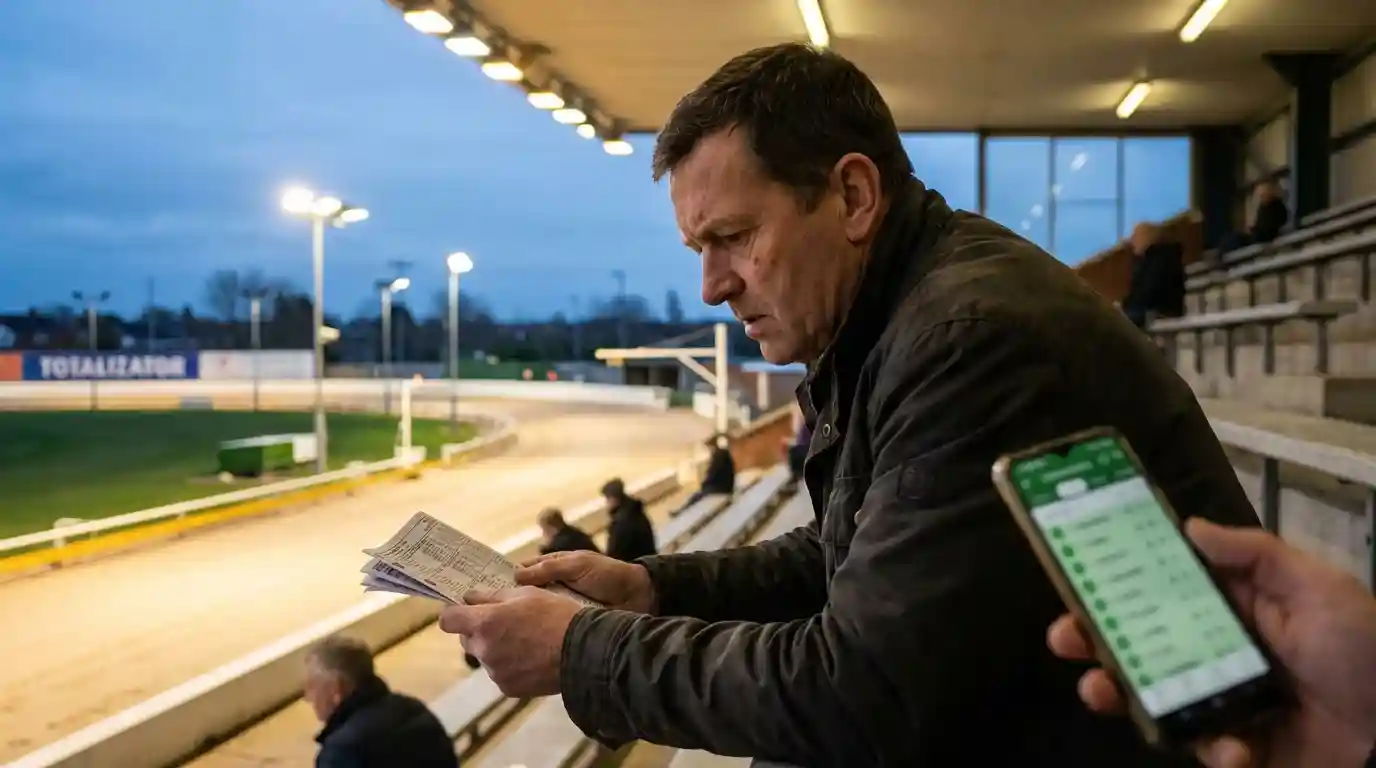
The second check is the trap draw and track bias. Check the trap win statistics for the specific track and distance before you assess the dog. If historical data shows trap 1 wins 22% of races at this distance and your dog is drawn there, factor that into your probability estimate. If your dog is a confirmed railer drawn wide, reduce your estimate accordingly. This takes thirty seconds and changes the analysis more often than most punters expect.
Third, distance suitability. A dog with outstanding sprint form may struggle over a longer middle-distance trip. Check whether the dog has run this distance before and how its sectional times compare — strong early pace with a fade in the run-in suggests a sprinter, not a stayer. Fourth, conditions. Track conditions affect greyhound performance, particularly when the sand is wet or recently watered. Some dogs handle heavy going better than others, and their form figures will reflect it if you look carefully.
Fifth, price versus probability. After assessing the first four factors, estimate what you believe the dog's true winning chance is as a percentage. Compare it to the implied probability of the bookmaker's price. If your estimate is higher, you have a potential value bet. If it is lower, move on or reassess before committing your stake.
Before you bet
- Check recent form in the current grade and distance — last three runs are the priority.
- Review trap draw and track-specific trap bias statistics.
- Confirm distance suitability — has the dog performed at this trip before?
- Assess track conditions and the dog's record on similar going.
- Estimate your own probability and compare it to the bookmaker's implied price.
- Check trainer form and any notable kennelmate patterns at this track.
Before you bet
- Check recent form in the current grade and distance — last three runs are the priority.
- Review trap draw and track-specific trap bias statistics.
- Confirm distance suitability — has the dog performed at this trip before?
- Assess track conditions and the dog's record on similar going.
- Estimate your own probability and compare it to the bookmaker's implied price.
- Check trainer form and any notable kennelmate patterns at this track.
Where the Dogs Run: UK Tracks and What Makes Them Different
Not all tracks are equal — and neither are the dogs that run at them. The UK greyhound circuit comprises tracks licensed by the Greyhound Board of Great Britain (GBGB), each with its own dimensions, surface characteristics, and trap biases. The track your dog is running at is not background detail. It is the first variable to consider, because a dog's form at Romford tells you almost nothing about how it will perform at Nottingham. Different circuits, different geometry, different outcomes.
Romford is a tight, sharp circuit where the run to the first bend is short and inside traps dominate. Early pace and clean trapping are essential — a slow-away dog at Romford faces an immediate disadvantage because there is no room to recover before the bend. Crayford is similarly compact but with slightly more forgiving bends. Both tracks favour front-runners and rail dogs. Nottingham, by contrast, is a larger, more galloping circuit where strong finishers can make up ground in the home straight. Trap bias is less pronounced at Nottingham, and dogs with tactical speed rather than pure early pace tend to perform well.
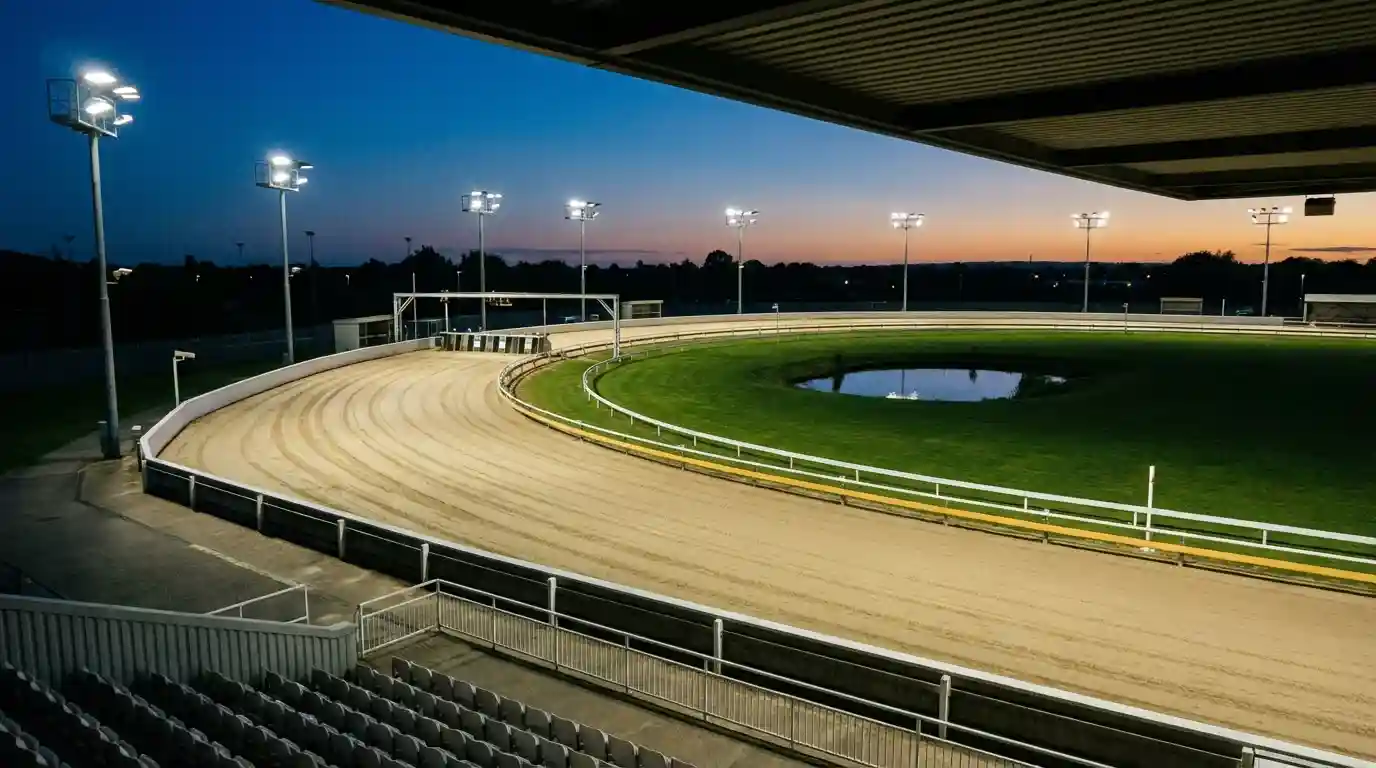
Newcastle (formerly Brough Park) is one of the fastest tracks in the UK and produces quick times across its standard distances. Monmore Green near Wolverhampton runs a 480-metre standard trip and is known as a fair track with moderate trap bias. Sheffield Owlerton is another galloping circuit that rewards middle-distance stamina. Hove, near Brighton, has been a cornerstone of southern greyhound racing and runs on a tight configuration similar to Romford.
The practical takeaway is specialisation. Rather than spreading your analysis thinly across every track on the BAGS schedule, pick two or three circuits and learn their characteristics in detail — trap statistics at each distance, how different going conditions affect times, which trainers are locally based and carry the best strike rates. A punter who understands Romford inside out will consistently identify value that a generalist, scanning six tracks a night, will miss. In the 2026 BAGS and BEGS schedule, which runs over twenty meetings per week across the GBGB circuit, there is no shortage of racing. The skill is in narrowing your focus, not widening it.
The Greyhound Racing Calendar: Biggest Betting Events
Derby night changes everything — the ante-post market opens months out and the money talks. While the BAGS schedule provides daily betting opportunities, the flagship events on the UK greyhound calendar attract the deepest markets, the sharpest odds movement, and the most informed money. Knowing when these events run and what to look for in the ante-post market is part of the serious punter's annual planning.
The English Greyhound Derby is the sport's premier event, run over 500 metres at Towcester. It is the race every owner and trainer targets, and the ante-post market opens well in advance of the first-round heats. Early prices on Derby contenders can offer genuine value because the field is large and the form picture is incomplete before the heats begin. Once the first-round results are in, prices tighten rapidly. For the 2026 edition, the early rounds provide the best window for ante-post value before the market corrects.
The St Leger, run over a longer distance of 730 metres, tests stamina rather than pure speed and produces a different type of finalist. The Select Stakes is another major event on the calendar, typically run at sprint distance. The Scottish Greyhound Derby, formerly run at Shawfield near Glasgow, was one of the sport's original classic competitions before the final edition was held in 2019 and Shawfield Stadium subsequently closed. The Essex Vase at Romford is a prestigious middle-distance event run over 575 metres that rewards dogs with sustained pace and tactical running suited to that tight circuit.
For punters, the major events represent both opportunity and trap. The opportunity is clear: deeper markets, more available form data, and the potential for substantial ante-post returns if you identify a contender early. The trap is equally clear: the public betting volume surges during major events, favourites attract disproportionate money, and the overround can widen as bookmakers respond to increased liability. The same disciplined approach that works on a Tuesday afternoon BAGS card — form analysis, trap assessment, price comparison — applies to Derby night. The stakes are higher. The process is the same.
Greyhound Betting Odds: Your Questions Answered
How do bookmakers calculate greyhound racing odds?
Bookmakers start by assessing each dog's recent form, trap draw, grade, trainer record, and running style to estimate the probability of each runner winning. These probabilities are converted to odds, then adjusted to build in an overround — the bookmaker's profit margin, typically 115–125% across a six-dog race. After the initial prices are set, the market reacts to punter money: dogs attracting heavy support shorten in price, while those receiving little interest drift. The Starting Price captures the final state of the market at trap rise. The odds are not a pure prediction — they are a commercial product balanced between probability assessment and liability management.
What does SP mean and should I take the price or wait for Starting Price?
SP stands for Starting Price — the official odds returned at the moment the traps open, as recorded by independent SP reporters watching the on-course market. Whether to take an early fixed price or wait for SP depends on your assessment of market direction. If you believe the dog will attract support and shorten, take the price early to lock in value. If you think the dog will drift or if you are unsure, waiting for SP is reasonable — especially if your bookmaker offers Best Odds Guaranteed, which pays the better of your fixed price and the SP on qualifying BAGS and BEGS meetings. BOG removes much of the timing risk.
How often does the favourite win in greyhound racing — and what does that mean for my bets?
The favourite wins approximately 35% of UK graded greyhound races. This means the market leader fails roughly two out of every three races. For punters, the implication is significant: blindly backing favourites is a losing strategy over time because the short odds rarely compensate for the 65% failure rate. The real opportunity lies in the second, third, and fourth choices in the market, where public money tends to be lighter and bookmaker prices can overestimate a dog's chance of losing. Consistent profit comes from identifying value across the full field, not from following the crowd onto short-priced favourites.
The Dogs Won't Wait — But Your Homework Should
The smartest greyhound punters are not the luckiest — they are the most patient. They read the card before they read the odds. They know which tracks suit which running styles. They understand the difference between a dog that won its last race and a dog that deserved to win its last race. And when the form tells them there is no bet worth making on this card, they close the app and wait for the next one.
Greyhound racing rewards preparation and punishes impulse. The compressed six-dog field and the relentless pace of the BAGS schedule — races every twelve to fifteen minutes, meetings running from late morning through the evening — create a rhythm that pulls the undisciplined punter into constant action. That rhythm is the trap. The edge belongs to the punter who sits out six races and bets on the seventh, because the seventh is the one where form, trap draw, price, and conditions all align.
Technology has changed the access point. Live streaming, mobile racecards, real-time odds comparison — all of this puts more information in your hands than any previous generation of greyhound bettors had available. But the information is only an advantage if you use it methodically. The dog does not care about your app. The bookmaker does not care about your system. The only thing that matters is whether the price is right and whether your analysis supports the bet. If it does, take the price. If it does not, wait. The dogs will still be running tomorrow.
