History of Greyhound Racing and Betting in the UK
 Available in US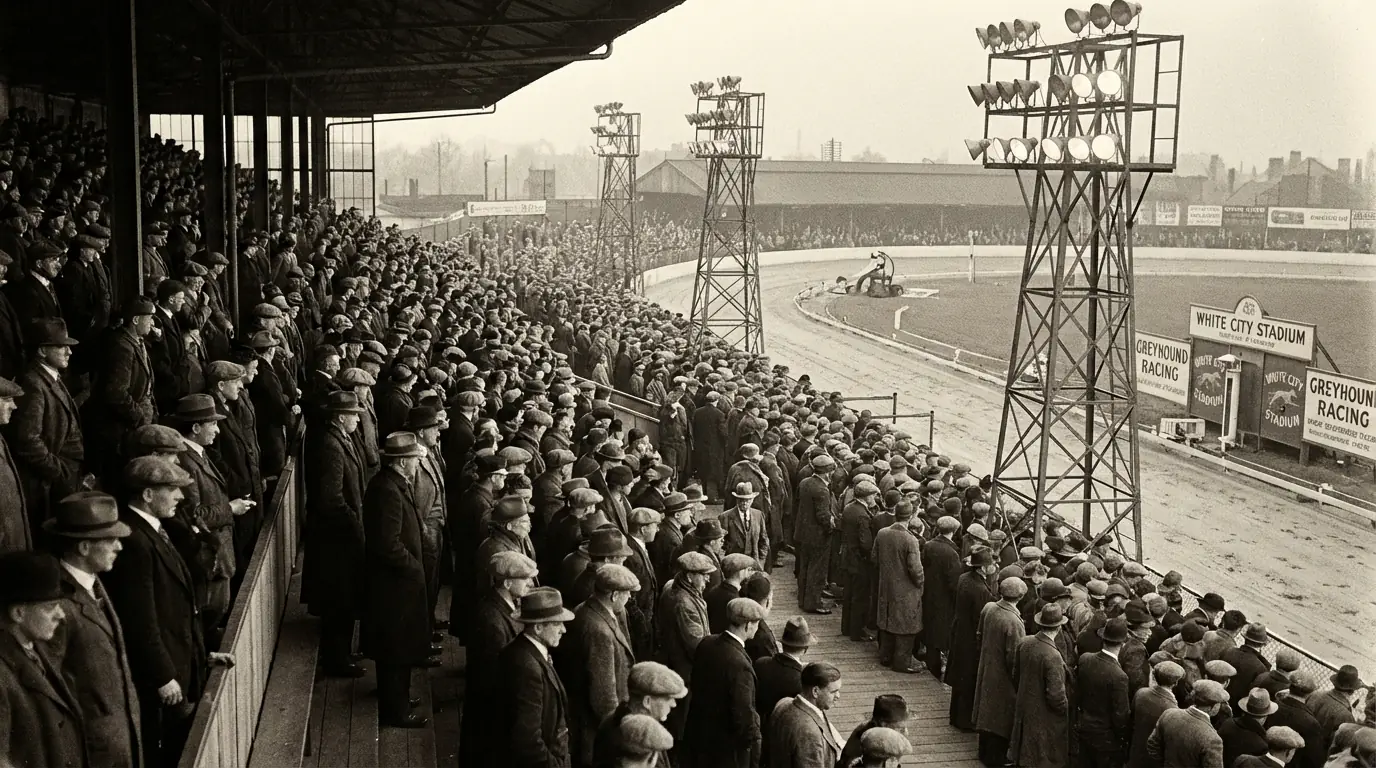
A Sport Built on Speed, Sand, and Saturday Nights
Greyhound racing in Britain is not an ancient tradition. It’s a twentieth-century invention — an urban entertainment born from the marriage of an artificial hare, a handful of fast dogs, and a public hungry for accessible, affordable spectacle. Within five years of its first organised meeting, it was drawing tens of millions of spectators annually and generating a betting turnover that rivalled horse racing. Within a generation, it had become woven into the social fabric of working-class Britain in a way that no other sport quite matched.
The story of UK greyhound racing is inseparable from the story of British betting. The sport was shaped by gambling legislation, sustained by betting revenue, and transformed by the same technological shifts — television, the internet, mobile phones — that reshaped the entire UK gambling industry. To understand where greyhound betting stands today, you need to understand where it came from.
Origins: Belle Vue 1926 and the Explosion That Followed
The first modern greyhound race meeting in Britain took place on 24 July 1926 at Belle Vue Stadium in Manchester. The concept — dogs chasing a mechanical hare around an oval track — had been developed in the United States, but it found its spiritual home in the industrial cities of northern England and Scotland, where large populations of working people had limited disposable income and limited entertainment options. Greyhound racing offered an evening out, a social occasion, and the chance to have a bet — all for the price of admission.
The growth was explosive. Within twelve months of the Belle Vue meeting, tracks opened in London, Glasgow, Edinburgh, Birmingham, and dozens of smaller towns. By the end of the 1920s, there were over seventy licensed greyhound tracks operating in the UK, and annual attendances were already in the millions. The speed of this expansion reflected genuine public demand: here was a sport that required no specialist knowledge to enjoy, took place in the evening when people were free from work, and offered betting at a time when legal off-course gambling was essentially non-existent.
The early tracks were entrepreneurial ventures, often converted from football grounds, athletics stadiums, or open land on the urban fringe. The racing was organised but loosely regulated, and the quality varied widely between venues. Some tracks ran to high standards with properly graded racing and legitimate betting operations. Others were rougher affairs where the integrity of the competition was questionable. The need for a governing body became apparent quickly, and the National Greyhound Racing Club (later to become the GBGB) was established to license tracks, register dogs, and enforce rules of racing.
Betting at these early meetings was exclusively on-course — there were no betting shops, no telephone accounts, and no off-course bookmakers legally permitted to take bets on greyhounds. The tote system, introduced at tracks during the late 1920s and early 1930s, provided a pool betting option alongside the on-course bookmakers. This dual system — bookmakers and tote operating side by side at the track — became the standard structure for greyhound betting and persists in modified form to this day.
The Golden Age: Post-War Greyhound Racing as Mass Entertainment
The period from the late 1940s through to the 1960s is widely regarded as the golden age of British greyhound racing. Attendances peaked at extraordinary levels — an estimated 34 million admissions to licensed tracks alone in 1946, with the total across all venues including independent tracks believed to exceed 70 million, making greyhound racing one of the best-attended sports in the country. The White City stadium in London, which hosted the Greyhound Derby, was one of the most famous sporting venues in Britain, and the Derby itself was a national event covered by the press and followed by millions.
The appeal was rooted in accessibility. Greyhound meetings took place in the evening, typically on weeknights, allowing working people to attend after their shift. Admission was cheap. The racing was fast, frequent, and easy to follow — six dogs, one race every fifteen minutes, with clear results and immediate payouts. The atmosphere at a packed stadium on a Saturday night — floodlights, the roar of the crowd as the traps opened, the clink of coins at the tote windows — was a genuine cultural experience, not just a sporting one.
Betting drove the economics. The on-course betting market — both tote and bookmaker — generated the revenue that sustained the tracks, paid the prize money, and funded the infrastructure. The tote take alone was substantial, and the bookmakers’ presence attracted punters who preferred fixed-odds to pool betting. The symbiotic relationship between racing and gambling was not just accepted but celebrated: the dogs ran, the punters bet, and the money circulated through an ecosystem that employed thousands and entertained millions.
The decline began in the 1960s, driven by a combination of factors. The Betting and Gaming Act 1960, which legalised off-course betting shops from May 1961, drew punters away from the track and into the high street. Television brought competing entertainment into the home. Car ownership expanded leisure options beyond the local stadium. Tracks that had been packed in the 1950s saw attendance drop steadily through the 1960s and 1970s, and the commercial pressure on urban-fringe sites — valuable real estate in expanding cities — led to track closures that accelerated from the 1970s onwards.
The Modern Era: Fewer Tracks, More Betting, Different World
The UK greyhound racing landscape in 2026 is dramatically different from its mid-century peak. The number of licensed tracks has shrunk from over seventy at the sport’s height to eighteen GBGB-licensed venues. The major closures — Wimbledon in March 2017, the decades-long attrition of London’s once-dense network of stadiums — have concentrated the sport into fewer, better-maintained venues with modern facilities and professional racing programmes.
What has not declined is the volume of betting. The shift from on-course to off-course betting, and then from betting shops to online platforms, transformed the economic model. BAGS and BEGS meetings — racing specifically scheduled for off-course consumption — now account for the vast majority of daily greyhound racing in the UK. These meetings are broadcast live to betting shops and streamed online, generating betting turnover that sustains the sport even as trackside attendance remains a fraction of its historical peak.
The regulatory environment has tightened substantially. The GBGB oversees welfare standards, drug testing, track licensing, and the integrity of the betting product. The Gambling Commission regulates the betting operators. Together, these bodies have professionalised both the racing and the betting to a degree that the early pioneers at Belle Vue would barely recognise. Modern greyhound racing in the UK operates within a regulated framework that prioritises dog welfare, racing integrity, and responsible gambling.
The betting product itself has evolved. Online accounts, live streaming, in-play markets, betting exchanges, and mobile apps have made greyhound betting more accessible and more data-rich than at any point in the sport’s history. A punter in 2026 has access to form databases, sectional times, trap statistics, and live video from their phone — information that was available only to trackside regulars a generation ago. This democratisation of data has changed who bets on greyhounds and how they approach it.
A Hundred Years of Dogs and Bets
Greyhound racing in Britain is approaching its centenary as an organised sport. Its trajectory — from an imported novelty in a Manchester stadium to a mass entertainment phenomenon to a smaller, professionalised industry sustained by a global betting market — mirrors the broader story of British leisure and gambling culture across the twentieth and twenty-first centuries.
The tracks are fewer. The crowds are smaller. But the racing is faster, the data is deeper, and the betting market is more sophisticated than it has ever been. The dogs still chase the hare. The punters still back their fancy. And the fundamental appeal — speed, competition, and the chance of making a good bet — is exactly what it was when those six greyhounds broke from the traps at Belle Vue on a July evening in 1926.
