UK Greyhound Racing Tracks: The Complete Venue Guide
 Available in US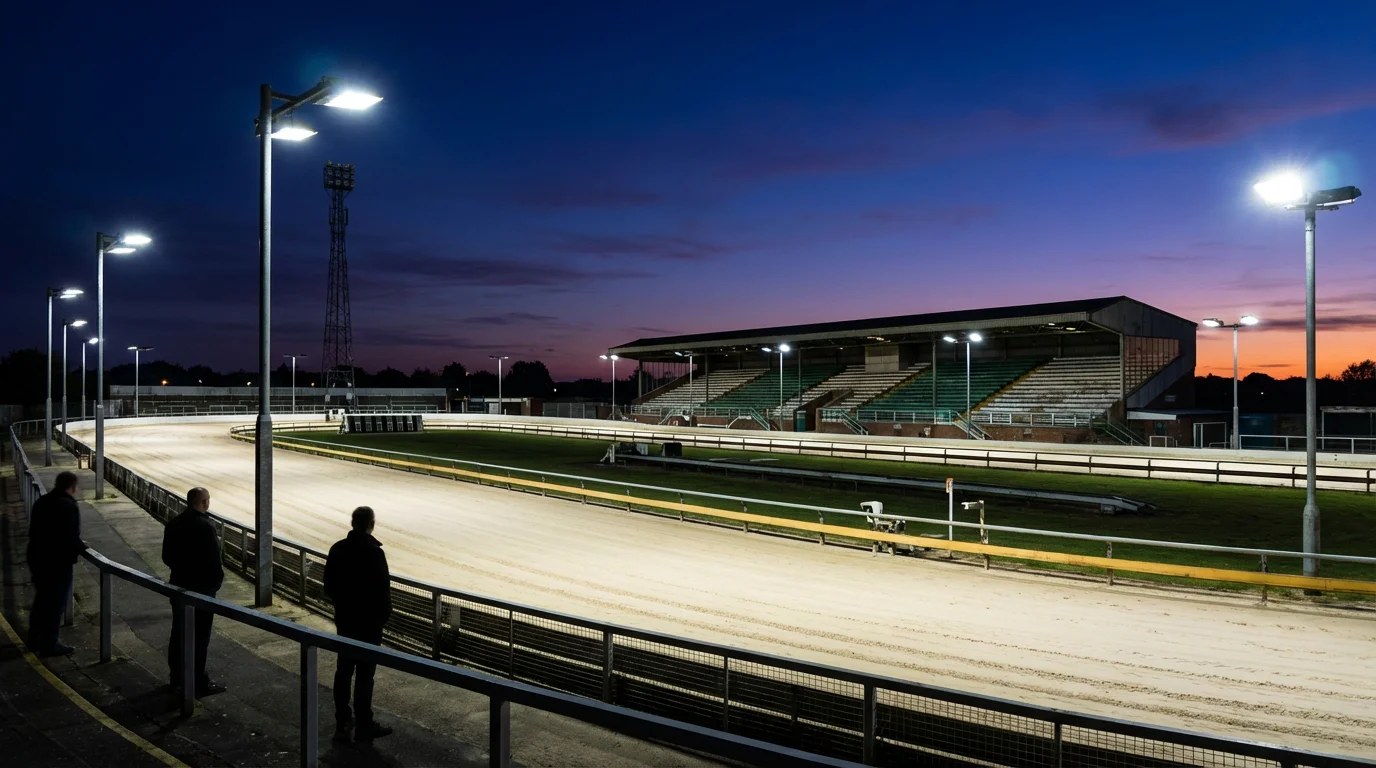
Every Track Has a Personality — and It Shapes the Odds
The sand at Romford runs fast and tight. Nottingham’s bends are wider and kinder to closers. Crayford has produced more dramatic last-bend finishes than any track in London. Every greyhound stadium in Britain has its own physical characteristics — bend profiles, straight lengths, surface conditions, trap biases — and those characteristics influence race outcomes in ways that the form string alone doesn’t capture. A dog that dominates at one track can struggle at another, not because it’s lost ability but because the circuit doesn’t suit its running style. Know the track, know the edge.
For punters, track knowledge is one of the most reliable and accessible advantages available. The data is public. The distances are published. The trap statistics are compiled by independent sites. Yet most recreational bettors treat every track as interchangeable — a six-dog race is a six-dog race, wherever it’s run. That assumption costs them money. The punter who understands how Romford’s sharp bends favour railers, or how Nottingham’s long run to the first turn reduces the inside draw advantage, is operating with a structural edge that no amount of form analysis can replicate without venue context.
This guide profiles every active GBGB-licensed track, covers the meeting types that determine when and how you can bet, walks through the flagship events on the greyhound racing calendar, and addresses the regulatory standards that underpin the sport. By the end, the map of UK greyhound racing should feel less like a list of names and more like a landscape you can navigate with purpose.
UK Greyhound Tracks: The Full List
There are 18 GBGB-licensed stadia across England and Wales, with racing taking place almost every day of the year. The tracks range from compact sprint circuits in Greater London to larger, purpose-built venues in the Midlands and North. All operate on sand surfaces — there are no turf or synthetic greyhound tracks in the UK — though the sand composition and depth varies between venues, which affects going conditions and run times.
The major circuits include Romford and Hove in the south; Nottingham, Monmore Green, and Perry Barr in the Midlands; Newcastle, Sunderland, and Sheffield in the north; and Towcester, which serves as the home of the English Greyhound Derby. Other active venues include Henlow, Yarmouth, Doncaster, Central Park, Kinsley, and Valley — the sole remaining Welsh track. Crayford, which was a significant London venue for decades, closed permanently in January 2025.
Each track offers a range of distances, typically spanning from around 250 metres (sprint) to 640 metres or more (staying). The standard race distance at most venues sits between 400 and 500 metres, which represents the core middle-distance trip that forms the bulk of weekly graded racing. Not every track offers every distance, and the specific race menu varies by venue — another reason why track-specific knowledge matters when assessing form from different circuits.
The physical design of each circuit — its circumference, the tightness of its bends, the length of the home straight, the positioning of the traps relative to the first turn — creates a set of biases that persist across thousands of races. Tight tracks with sharp bends favour inside draws and early pace. Wider tracks with sweeping turns reduce the rail advantage and give closing dogs more room to operate. These structural differences mean that a dog’s performance at one venue is an imperfect predictor of its performance at another, and the gap between the two is where track knowledge creates value for the informed punter.
The Key Tracks Every Greyhound Punter Should Know
Some tracks you bet at. These are the tracks you study — the venues that host the most significant racing, attract the strongest fields, and offer the most detailed data for punters to work with. Understanding the personality of each gives you context that transforms raw form figures into meaningful analysis.
Romford: The Sprint Capital
Romford is a tight, fast track in east London that has been staging greyhound racing since 1929. The circuit is compact with sharp bends, which gives a pronounced advantage to dogs drawn on the inside — trap 1 and trap 2 historically outperform at Romford more than at almost any other GBGB venue. The sharp geometry punishes wide runners and rewards dogs that break fast and hold the rail. If you’re going to specialise in one track for sprint betting, Romford has the data density and the meeting frequency to support it.
The standard distances at Romford are 225, 400, and 575 metres, with the 400-metre trip forming the core of most meeting cards. The track hosts several prestigious open races throughout the year, including the Essex Vase, the Champion Stakes, and the Golden Sprint. For bettors, Romford’s compressed circuit means that early pace is at a premium — dogs that get to the first bend in front win a disproportionate share of races here compared to wider, more forgiving tracks.
Nottingham: Derby Venue and Beyond
Nottingham Greyhound Stadium sits two miles from the city centre and is one of the most respected venues in the sport. The track is wider than Romford with more sweeping bends, which means the inside draw advantage is less pronounced and closing dogs have more opportunity to make ground through the turns. This makes Nottingham a track where finishing speed carries genuine weight, and where form from tighter circuits doesn’t always translate directly.
Nottingham’s key distances are 305, 500, and 680 metres. The track has hosted the Select Stakes — one of the sport’s most prestigious invitation events — and regularly stages high-quality open racing. The 500-metre trip is the main racing distance and produces form that is particularly useful for assessing Derby contenders, since the English Greyhound Derby at Towcester is also run over 500 metres. Dogs with proven Nottingham form over the standard trip often carry that ability to Towcester’s similarly proportioned circuit.
For punters, Nottingham’s wider configuration produces more open, competitive races where the early pace doesn’t dictate the result as reliably as at Romford. Dogs stepping up from smaller tracks sometimes improve here, and the reverse is equally true — a dog that runs well around Nottingham’s generous bends may struggle when confronted with the tighter geometry at Romford or Crayford. The track’s consistent surface and reliable data coverage make it an excellent candidate for specialisation, particularly for punters interested in the middle-distance and staying divisions.
Crayford, Newcastle, and Other Premier Venues
Crayford was London’s other major track, situated in south-east London with a racing history stretching back to 1937. The current stadium, rebuilt in 1986, closed permanently on 19 January 2025 after owner Entain determined it was no longer viable. In its final years, the track staged the Golden Jacket, the Gold Collar, and the Kent St Leger annually, making it one of the most significant venues on the open racing calendar. Crayford’s bends were moderate — not as sharp as Romford, not as wide as Nottingham — which produced a balanced racing profile where both early pace and finishing speed had their days. The standard distances included 380, 540, and 714 metres. The 714-metre marathon trip at Crayford was one of the longest in regular UK greyhound racing and attracted a specialist field of stayers. With Crayford’s closure, the future hosting of its flagship competitions remains uncertain.
Newcastle has been a home to greyhound racing for over ninety years and is the dominant venue in the north-east. The stadium offers modern facilities and hosts the prestigious All England Cup. Newcastle’s track is medium-sized with distances of 280, 480, and 640 metres, and it draws competitive fields that include dogs from some of the strongest northern kennels. Sunderland, the other major north-east venue, complements Newcastle with its own fixtures and provides a useful form comparison for dogs that race at both tracks.
In the Midlands, Monmore Green in Wolverhampton and Perry Barr in Birmingham stage frequent BAGS meetings and attract strong regional fields. Monmore’s tight circuit shares some characteristics with Romford — the inside draw carries value — while Perry Barr’s layout is more neutral. Hall Green, also in Birmingham, has a long history and hosts regular open competition. Hove on the south coast offers a fast, flat track with distances from 285 to 695 metres, and its proximity to Brighton gives it a loyal local following. Sheffield in South Yorkshire provides another northern option with a well-maintained circuit and regular evening racing.
Towcester deserves particular mention. Originally a horse racing venue, the Northamptonshire track was developed as a purpose-built greyhound racing facility and has served as the home of the English Greyhound Derby since the event moved from Wimbledon. The track’s 500-metre Derby course is regarded as one of the fairest in the sport — wide enough to give every trap a genuine chance, with bends that test a dog’s agility without punishing wider runners unfairly. Towcester’s elevated status means it stages the biggest single event in British greyhound racing, and for ante-post bettors, understanding the Towcester circuit is essential preparation for Derby season.
BAGS and BEGS Meetings: What They Mean for Bettors
If you’re betting on greyhounds online during the day, you’re almost certainly betting on a BAGS meeting — and the rules around odds availability, Best Odds Guaranteed, and live streaming depend on it. BAGS stands for Bookmakers’ Afternoon Greyhound Service, a contractual arrangement between the tracks and the bookmaking industry that provides a schedule of afternoon racing specifically for off-course betting purposes. BEGS — the British Evening Greyhound Service — operates on the same principle for selected evening fixtures.
BAGS meetings run from late morning through the afternoon, typically across three or four venues simultaneously, providing a continuous stream of races for bookmakers to offer. These are the bread-and-butter of greyhound betting: standard graded races, usually six-dog fields, with prices available from around thirty minutes before each race. The majority of online greyhound betting in the UK is placed on BAGS fixtures, and most bookmaker promotions — including Best Odds Guaranteed — are specifically tied to BAGS and BEGS meetings.
The distinction matters because not all greyhound racing falls under the BAGS or BEGS banner. Independent evening meetings, open race nights, and trial sessions may not have full bookmaker coverage. Odds may be available from fewer operators, live streaming may be limited, and promotional offers may not apply. For punters who rely on BOG as part of their pricing strategy, confirming that a meeting is a BAGS or BEGS fixture before placing the bet is a practical habit worth building.
BAGS meetings also tend to feature graded racing rather than open competition, which means the fields are assembled by the racing office based on the dogs’ current grades rather than by invitation or entry fee. This produces more predictable form lines — dogs race against others of broadly similar ability — which in turn makes form analysis more reliable than at open meetings where the class spread can be wider. For systematic punters, BAGS racing offers the combination of data density, consistent race conditions, and promotional coverage that makes it the natural focus for regular betting activity.
The UK Greyhound Racing Calendar: Flagship Events
The greyhound racing calendar builds through the year towards a cluster of major events in the spring and summer months, with significant open races scattered across the autumn and winter schedule. For bettors, the flagship events offer something that standard graded racing doesn’t: ante-post markets, multi-round competitions, and fields assembled from the best dogs in training rather than from a single track’s grading pool. The betting dynamics change accordingly — the markets are deeper, the form analysis more complex, and the potential rewards for getting it right are substantially larger.
The English Greyhound Derby
The Derby isn’t just a race — it’s a six-round tournament where fortunes shift after every heat. The English Greyhound Derby is the single most prestigious event in British greyhound racing, first held in 1927 at White City and currently staged at Towcester Racecourse over 500 metres. The winner’s prize stands at £175,000, making it the richest greyhound race in Britain. The competition attracts approximately 180 entries each year, whittled down through heats, quarter-finals, and semi-finals to a six-dog final, typically held in late May or June.
For bettors, the Derby format creates unique opportunities. The ante-post market opens months before the first heat, with prices based on reputation, trial times, and early form. As the rounds progress, the market adjusts — a dog that wins its first-round heat impressively will shorten; a fancied entry that scrapes through will drift. Each round produces new form data that can be used to reassess the contenders. Punters who follow the competition from the early heats have an informational advantage over those who only engage for the semi-finals and final, because they’ve seen how each dog handles the Towcester circuit under competitive conditions rather than relying on form from other tracks. The multi-round format also creates natural price corrections — a dog whose early-round performances don’t match the ante-post hype will drift, sometimes to a price that represents value if the initial assessment was sound.
2026 marks the centenary of organised greyhound racing in Britain, and the GBGB has announced an expanded calendar of category one events to celebrate the milestone. The Derby will be at the centre of the celebrations, with a supporting card designed to showcase the sport’s depth and diversity.
St Leger, Select Stakes, and Other Major Opens
The St Leger is greyhound racing’s classic distance test, run over 640 metres or more depending on the hosting track. It demands stamina as well as speed, and the form profile of a St Leger contender is different from a Derby dog — staying power and the ability to sustain pace through four or more bends matter more than raw early pace. For bettors, the St Leger offers value because the stayers’ division is smaller and less heavily scrutinised by the general market, meaning informed punters can find prices that don’t fully reflect a dog’s distance credentials.
The Select Stakes at Nottingham is an invitation event that brings together the best dogs in training for a high-quality short-format competition. The invited nature of the field means the form is typically strong across all six runners, which produces tight, competitive races with narrow margins. Ante-post betting on the Select Stakes tends to be less volatile than on the Derby because the field is smaller and the form lines more established.
Other major events include the Golden Jacket and Gold Collar (historically staged at Crayford, now seeking a new venue following the stadium’s 2025 closure), the All England Cup at Newcastle, the Essex Vase at Romford, the Eclipse at Nottingham, and the Champion Hurdle for hurdlers. Each carries significant prize money by greyhound racing standards and attracts entries from the top kennels. The full calendar of category one and category two open races is published by the GBGB before the start of each season, and for punters who engage with ante-post betting, reviewing this schedule early is the first step in planning which events to focus on.
GBGB Standards and Greyhound Welfare
Every GBGB-licensed track operates under strict welfare protocols — understanding them matters as a bettor and as a participant in the sport. The Greyhound Board of Great Britain regulates all aspects of licensed greyhound racing, from track facilities and starting traps to trainer kennels and veterinary provision. All racing greyhounds must be microchipped, vaccinated annually against distemper, hepatitis, parvovirus, and leptospirosis, and covered by a retirement bond before they’re permitted to race. Every track is required to have veterinary facilities on site, and each dog is examined by a vet before and after racing.
The GBGB’s retirement bond scheme, introduced in 2020, ensures that the costs of homing a greyhound after its racing career are met by the owner. Retirement data is published publicly, and the Greyhound Trust operates as the principal adoption organisation in Britain, rehoming thousands of retired racers each year. The sport is not without its critics — welfare organisations have raised concerns about injury rates and the fate of dogs that don’t make the grade — and bettors should be aware that greyhound racing operates in a regulatory and political environment that continues to evolve. The Welsh Government announced a ban on greyhound racing in February 2025, and similar legislation has been proposed in Scotland.
For punters, the practical relevance of welfare standards is indirect but real. Well-regulated tracks with properly maintained surfaces produce more consistent running conditions, which in turn produces more reliable form data. Tracks that invest in facilities and veterinary care tend to attract better-quality trainers and dogs, which raises the standard of competition and makes form analysis more meaningful. The GBGB’s regulatory framework isn’t just about ethics — it’s also about the integrity of the racing product that your bets are placed on.
The Track Is Half the Story
A dog’s form is only as meaningful as the context around it — and context starts with the track. A string of firsts at a tight, rail-biased circuit means something different from a string of firsts at a wide, galloping track. A fast time over 400 metres at Romford isn’t directly comparable to a fast time over 400 metres at Monmore, because the circuits make different demands on the dogs running them. Without venue context, form is a set of numbers detached from the conditions that produced them.
The tracks profiled here aren’t just locations — they’re variables. Each one adds or subtracts value from a dog’s form depending on how the track’s characteristics interact with the dog’s running style, the trap draw, and the opposition. A railer drawn in trap 1 at Romford is a different proposition from the same dog in the same trap at Nottingham. The numbers on the racecard don’t change. The interpretation does.
For punters willing to invest the time, track knowledge is among the most durable edges in greyhound betting. Trap biases persist across seasons. Bend profiles don’t change between meetings. Trainer-track relationships build over years. The information is stable, cumulative, and — for those who study it — increasingly profitable as the depth of knowledge grows. Start with one track. Learn its rhythms. Then let the data tell you when the odds are wrong.
