Greyhound Each-Way Betting Explained
 Available in US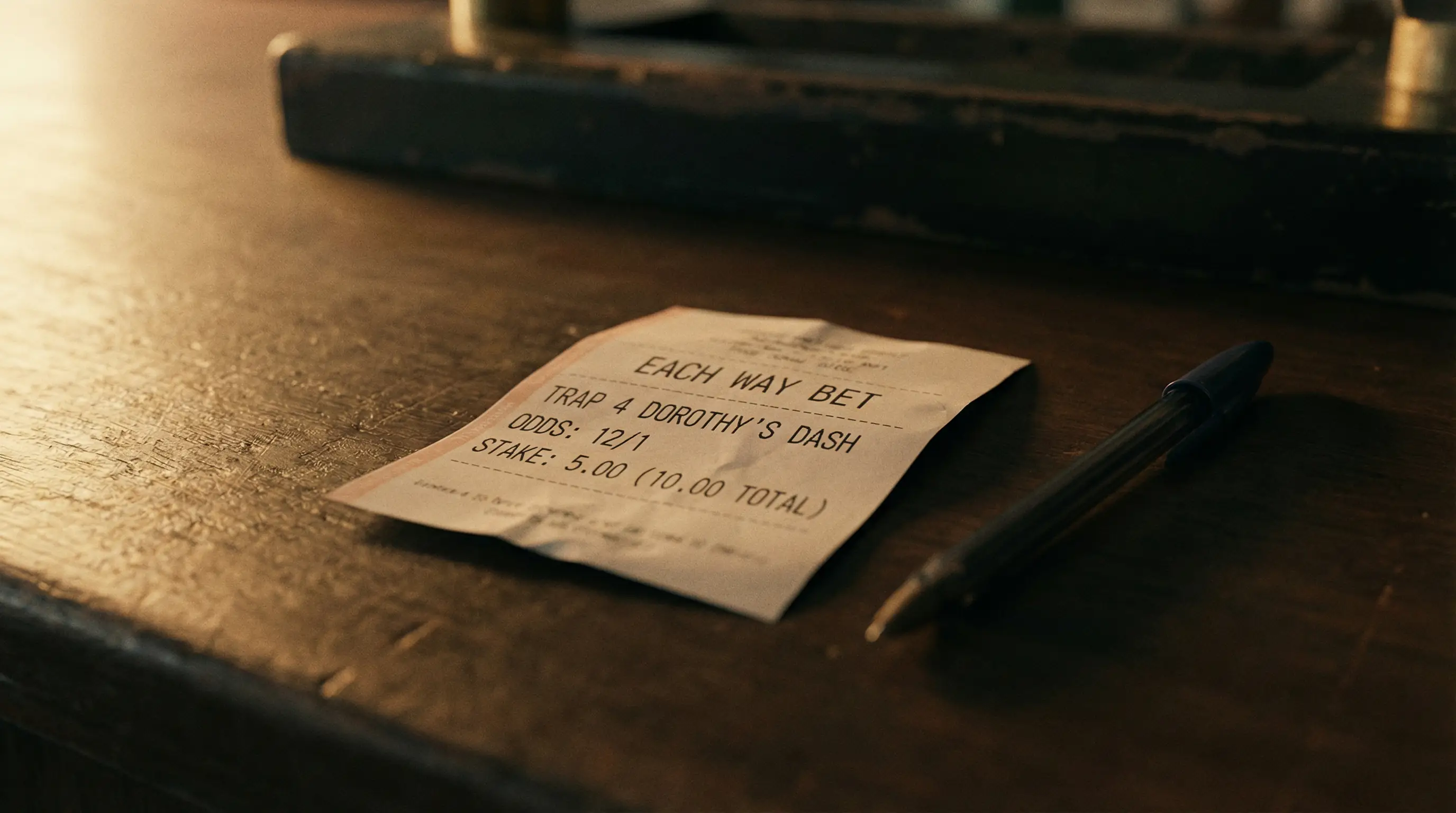
Each-Way on Greyhounds: The Bet Most Punters Use Wrong
Each-way is the punter’s insurance policy — but it costs double and the terms aren’t always generous. It’s also, by a comfortable margin, the most misunderstood standard bet in greyhound racing. Punters who use it instinctively on every selection are overpaying. Punters who never use it are missing clear opportunities. The truth sits somewhere between those two positions, and finding it requires understanding not just how each-way works mechanically, but when the maths actually favours it.
An each-way bet is two bets in one: a win bet and a place bet, at equal stakes. When you bet £5 each-way, you’re spending £10 total — £5 on the dog to win and £5 on the dog to place. If the dog wins, both parts pay out. If the dog places but doesn’t win, only the place part pays out. If the dog finishes outside the place positions, you lose both stakes. That doubling of the total outlay is the single most important thing to internalise about each-way betting. Every time you place an each-way bet, you’re committing twice the stake you might initially think.
In greyhound racing, each-way terms are standardised for six-runner fields: place means finishing first or second, and the place part of the bet is paid at one quarter of the win odds. These terms are notably less generous than horse racing, where larger fields produce more place positions (three or four) and sometimes better fractions (1/4 or 1/5 of win odds). With greyhounds, you get exactly two place spots and a quarter of the price. That’s it. The structural reality of six-runner races gives bookmakers less room to be generous, and they aren’t.
Each-Way Mechanics: How the Numbers Work
The calculation has two components, and they run independently. Start with the win part: if the dog wins, you’re paid at the full quoted odds, just as with a standard win bet. Then the place part: regardless of whether the dog wins or places second, the place bet is settled at one quarter of the win odds.
Run through an example. You back a greyhound at 8/1 each-way, £10 each-way (total stake: £20). If the dog wins, you receive: win bet returns £80 profit + £10 stake = £90, plus place bet at 2/1 (a quarter of 8/1) returns £20 profit + £10 stake = £30. Grand total: £120 from a £20 outlay. Strong result.
If the dog finishes second, only the place bet pays out: £20 profit + £10 stake = £30 from a £20 outlay. You’ve made £10 profit. Decent — you’ve been covered by the insurance element. If the dog finishes third or worse, both bets lose. You’re down £20.
Now consider the same scenario at shorter odds. The dog is 2/1 each-way, £10 each-way (£20 total). If it wins: win bet returns £20 profit + £10 = £30, plus place bet at 1/2 (quarter of 2/1) returns £5 profit + £10 = £15. Grand total: £45. If it places second: place bet returns £15 from £20 total stake. You’ve lost £5 despite your dog finishing in the frame. That’s the brutal reality of each-way betting at short prices — the place return doesn’t cover your total outlay.
This is why each-way betting on greyhound favourites is almost always a bad idea. At prices below 3/1, the place fraction is so small that a second-place finish returns less than your combined stakes. You need the dog to win for the bet to be profitable, which defeats the purpose of the insurance element.
Place Terms in Six-Runner Greyhound Races
In greyhound racing, place terms are fixed: first and second, at one quarter the win odds. There’s no variation based on field size because the field size is always six (or occasionally five if there’s a late withdrawal without a reserve). This consistency makes the each-way maths predictable but also inflexible.
Compare this to horse racing, where a 16-runner handicap might pay four places at one quarter odds, or a major festival race might offer enhanced terms of one fifth odds to five or six places as a promotional offer. Greyhound bettors never get those extras. Two places, quarter odds, every time. The consistency is convenient for calculation purposes, but it means each-way value is harder to find.
The limited place terms also mean that the each-way market is particularly sensitive to field composition. In a race where the favourite is odds-on and the second favourite is 5/2, the remaining four dogs are likely priced between 4/1 and 12/1. Each-way betting on those outsiders can be genuinely attractive because the place fraction at 4/1 (which gives 1/1 place odds) or higher provides meaningful returns for a second-place finish. By contrast, each-way on the 5/2 shot gives place odds of just 5/8, meaning a second-place finish barely breaks even.
Some bookmakers occasionally run enhanced each-way terms on specific greyhound meetings — paying three places instead of two, or offering one third of the odds instead of one quarter. These promotions are relatively rare on greyhounds compared to horse racing, but they can shift the value calculation significantly when available. If a bookmaker is paying three places on a six-runner greyhound race at one quarter odds, each-way suddenly becomes viable at much shorter prices. Keep an eye on promotional calendars.
When Each-Way Beats Win-Only on Greyhounds
The crossover point is roughly 3/1. Below that price, each-way on greyhounds is mathematically inferior to win-only in almost all realistic scenarios. Above 3/1, each-way starts to offer genuine protection that’s worth the additional stake — but only if you believe the dog has a realistic chance of placing even when it doesn’t win.
Think about it in terms of expected value. At 5/1 each-way, your place bet pays at 5/4. A dog that finishes second at 5/4 returns £12.50 from a £10 place stake — a modest profit that offsets part of your losing win stake. If you think the dog has, say, a 20% chance of winning and a 35% chance of finishing first or second, the each-way bet captures value from both outcomes. The win-only bet only captures the 20% scenario.
The ideal each-way greyhound bet is a dog priced at 4/1 or longer that has strong claims to place even if it doesn’t win outright. Classic examples include a fast starter in a race with a strong favourite — the outsider might not beat the favourite, but its early pace could secure second. Or a dog dropping in grade from a higher class — it may lack the edge to win against the top dog, but its overall quality suggests it’ll be competitive for a place.
Conversely, each-way is a poor choice for dogs whose chances are binary: they win or they’re nowhere. A greyhound known for either leading from the front or fading completely doesn’t suit each-way because its place probability is essentially the same as its win probability. You’re paying double the stake for protection that provides almost no additional coverage.
There’s also a bankroll consideration. Each-way doubles your exposure on every bet. If you’re backing three dogs across an evening’s card, each-way on all three costs six units instead of three. Over a sustained period, that doubling drains your bank faster during cold streaks. Selective use — each-way only when the price and profile justify it, win-only everywhere else — preserves capital and concentrates your each-way outlay where it actually adds value.
Each-Way as a Tool, Not a Default
The punters who profit from each-way greyhound betting are the ones who treat it as a conditional decision rather than a habit. They ask themselves, before every bet: does this dog have a realistic place chance that’s separate from its win chance? Is the price long enough for the place fraction to be meaningful? Would I be better off putting the full stake on the win and accepting the all-or-nothing outcome?
Those questions filter out the situations where each-way costs more than it’s worth — the short-priced favourites, the all-or-nothing front runners, the dogs in weak fields where the favourite dominates. What remains are the genuine each-way propositions: mid-range outsiders with honest form, dogs that consistently hit the frame even when they don’t win, and selections where the place odds alone represent value against their probability of finishing in the first two.
Each-way isn’t complicated. It’s two bets, two possible outcomes beyond a total loss, and one fraction to remember. But using it well means accepting that it’s not appropriate for every selection and every race. The insurance analogy holds: you don’t insure things that aren’t worth protecting, and you don’t pay premiums that exceed the value of the coverage. Apply the same logic to each-way greyhound betting, and you’ll use it when it works and skip it when it doesn’t.
