How Bookmakers Set Greyhound Odds
Best Greyhound Betting Sites – Bet on Greyhounds in 2026
Loading...
The Prices Aren’t Opinions — They’re Products
Most punters treat the odds on a greyhound racecard as the bookmaker’s honest opinion of each dog’s chance. They’re not. They’re a commercial product designed to balance liability, attract bets, and generate a margin regardless of the result. The bookmaker wants action on every runner. The prices are calibrated to produce that action while ensuring a mathematical edge baked into the market as a whole.
Understanding how bookmakers arrive at greyhound prices doesn’t give you a magic formula for beating them. But it does give you something arguably more useful: a framework for recognising when a price is shaped by the bookmaker’s liability management rather than the dog’s actual chance of winning. Those are the moments where value lives, and they appear more frequently than most punters realise — particularly in greyhound racing, where the markets are thinner, the form data is more compressed, and the bookmaker’s room for error is wider.
The pricing process follows a sequence: initial assessment, market opening, reactive adjustment, and final settlement. Each stage operates on different logic and different pressures. By the time you see a price on screen, it’s been through all four — and knowing what happened at each stage tells you more than the raw number ever could.
Initial Pricing: Form, Data, and the Opening Show
The process starts with a greyhound odds compiler — a specialist, either human or algorithmic, who translates race data into an initial set of prices. The compiler’s starting point is form: recent finishing positions, times at the distance, sectional data, trap draw, and grade. For a six-runner graded race, this is relatively straightforward. The dogs have recent form over similar distances at the same or comparable tracks, and the data tells a story the compiler can quantify.
The compiler’s first job is to assign a probability to each dog’s chance of winning. These tissue prices — the internal market before any punter sees a number — form the skeleton of the eventual public odds. In greyhound racing, the tissue is often tighter than in horse racing because the six-runner field constrains the range. The favourite might be assessed at 35% true probability, the second favourite at 22%, and the remaining four spread across the balance. Those percentages would add up to 100% in a perfectly fair market, but the bookmaker’s margin means they’ll add up to more — typically 115-125% for greyhound racing.
From the tissue, the compiler translates each probability into fractional odds. The 35% favourite becomes roughly 13/8 or 7/4 in standard fractional notation. The 22% second favourite lands at around 7/2. The compiler then adjusts these raw prices into conventional fractional steps — the traditional increments that bookmakers and punters recognise (evens, 5/4, 6/4, 7/4, 2/1, 5/2, 3/1, and so on). This adjustment introduces small rounding effects, which in practice slightly favour the bookmaker on most individual runners.
For BAGS and BEGS meetings, the initial prices typically appear between thirty minutes and two hours before the race, depending on the bookmaker. Some firms show early morning prices for afternoon cards, giving punters hours to assess and bet before the market develops. These early prices are the rawest version of the bookmaker’s assessment and are sometimes the most generous, particularly on dogs the compiler has rated slightly lower than the public ultimately will.
The compiler’s work is not infallible. On greyhound racing, compilers often have less granular data than horse racing equivalents — greyhound form databases are less extensive, trainer statistics are less readily available, and track-specific factors (rail bias, sand conditions) receive less analytical attention in the pricing model. These gaps create opportunities for punters who do their own homework. Further information on track operations and the rules governing them is available from the GBGB Rules of Racing.
Market Reaction: How Money Moves the Price
The moment the prices go live, the market starts talking back. Punters place bets, and the bookmaker’s trading team reacts. The process is continuous and, in the hour before a greyhound race, it can be rapid.
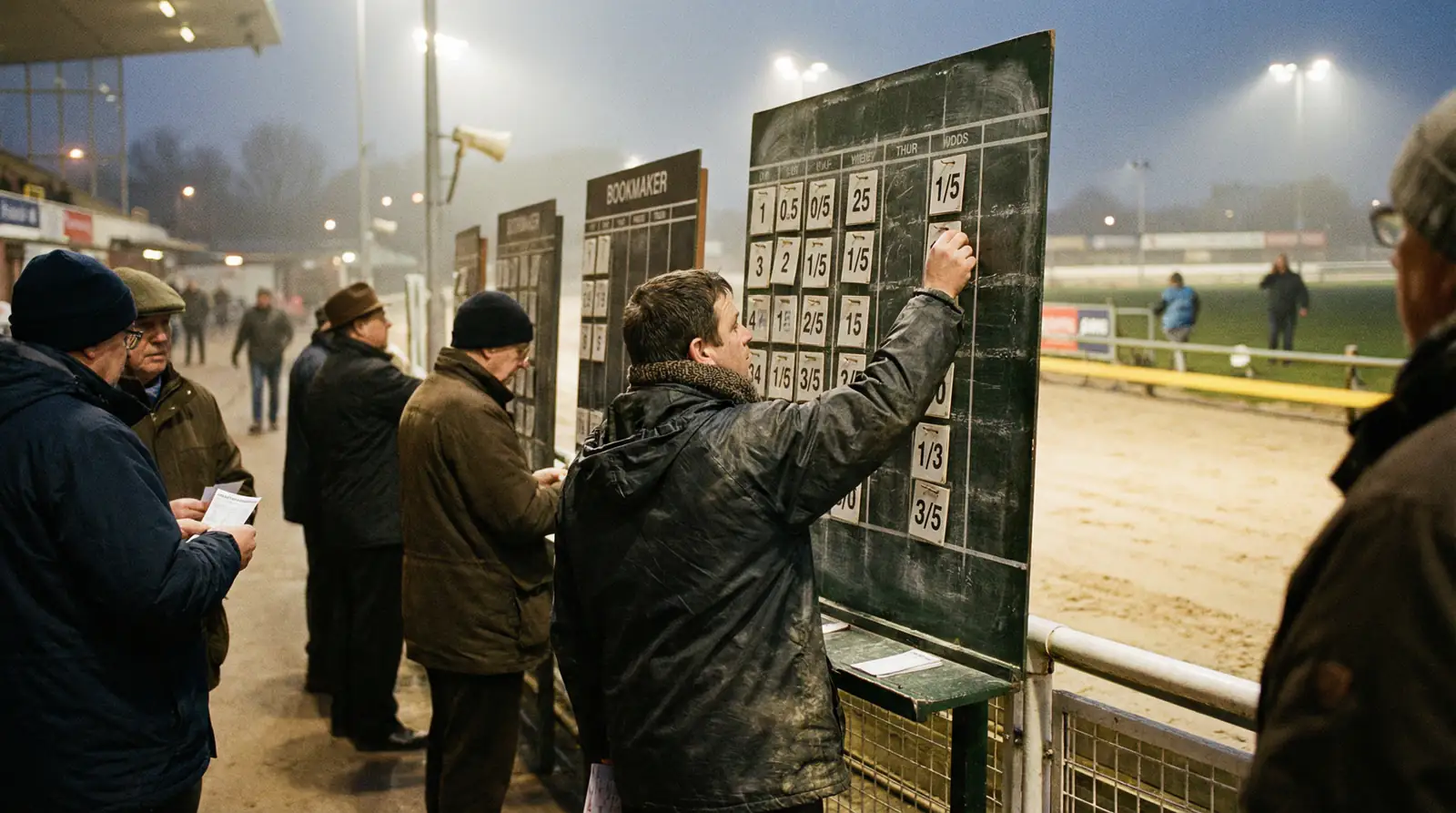
When a dog attracts heavy money, its price shortens. The bookmaker’s liability on that outcome increases, so the price is cut to discourage further bets and to lengthen the other runners, encouraging money to spread across the field. This is basic market making: the bookmaker doesn’t want all the money on one dog. A balanced book — where the total liability is covered regardless of which dog wins — is the ideal state, though it’s rarely achieved perfectly.
The speed at which greyhound prices react depends on the meeting and the bookmaker. For major evening fixtures with strong betting volumes, price movements can happen within minutes of each other. For quieter afternoon BAGS meetings, the market can be sluggish, with prices remaining static until a sharp bettor or a syndicate moves. This sluggishness is where alert punters sometimes find value: a price that should have shortened based on the weight of evidence remains available because the market hasn’t caught up yet.
Bookmakers also react to information beyond direct betting patterns. Late withdrawals, reserve runners replacing declared dogs, kennel reports of illness or injury, even the weight a dog comes in at — all of these can trigger price adjustments. In greyhound racing, the pace of information flow is faster than in horse racing because the gap between declaration and race is shorter. A greyhound’s weight is recorded on the day, not days in advance. Significant weight changes between races can move the price if the bookmaker’s traders notice and react.
Importantly, bookmakers also watch each other. When one major firm moves a greyhound’s price, others follow — sometimes within seconds. This herd effect means that early movers set the direction and the rest of the market falls into line. For punters, this creates a narrow window: the price change at the first bookmaker might not yet be reflected at the second, and that gap represents a brief arbitrage opportunity. On greyhound racing, where the market is smaller and fewer eyes are watching, these gaps persist slightly longer than on horse racing.
The Overround: How the Bookmaker Guarantees a Margin
Every price on a greyhound racecard is slightly shorter than the dog’s true implied probability. This systematic underpricing, when summed across all six runners, creates a total market percentage above 100%. The surplus is the overround — the bookmaker’s built-in profit margin on the race.
A typical greyhound race carries an overround of 115-125%. In practical terms, a 120% overround means the bookmaker retains roughly 17% of all money wagered on that race, assuming bets are spread proportionally to the odds. That’s a significant edge, and it exists before the first trap opens. The punter’s challenge is not to eliminate the overround — you can’t — but to identify individual runners where the bookmaker’s price exceeds the dog’s true probability, despite the overall market being in the bookmaker’s favour.
The overround varies between meetings and between bookmakers. Premium evening fixtures with strong liquidity tend to have tighter overrounds because competition between bookmakers drives prices closer to true probability. Midweek afternoon BAGS races at smaller tracks often carry wider overrounds because there’s less competitive pressure and fewer punters shopping for the best price.
For the punter, the overround serves as a quality-of-value indicator. Before assessing individual dogs, check the total market percentage. If it’s 130%, the margin of error you’re battling is substantial — every selection needs to be significantly mispriced for you to have an edge. If it’s 112%, the market is tighter and a smaller degree of mispricing can produce positive expected value. Targeting races with lower overrounds is one of the simplest structural advantages available.
The Price Is a Starting Point, Not an Answer
Bookmakers are skilled at pricing greyhound races. Their models are informed by data, their traders react to money, and the overround provides a safety net. But they’re not omniscient. They price hundreds of races daily across multiple tracks, and the depth of analysis per race is necessarily limited. Compilers make assumptions. Traders follow each other. Markets remain static when they should move.
Those imperfections are your opportunity. Every price you see is the product of a process — and when you understand the process, you can spot where it has underperformed. That’s not a guarantee of profit. It’s a way of asking better questions about a number that most punters accept at face value.