Greyhound Betting Exchanges
Best Greyhound Betting Sites – Bet on Greyhounds in 2026
Loading...
Exchanges Let You Be the Bookmaker — Here’s What That Means
A betting exchange is a platform where punters bet against each other rather than against a bookmaker. You can back a greyhound to win, just as you would with a traditional bookmaker, but you can also lay a greyhound — effectively betting that it won’t win. This changes the entire structure of how greyhound betting works. On an exchange, you’re not accepting the price a bookmaker offers. You’re either offering a price or accepting one that another user has set, and the exchange takes a commission on winning bets rather than building a margin into the odds.
For greyhound racing, exchange betting occupies a smaller share of the market than for horse racing, but it’s growing steadily and offers advantages that traditional bookmakers can’t match. The ability to lay, to trade positions before and during races, and to access odds that are frequently better than bookmaker prices makes exchanges a serious tool for any greyhound punter willing to learn the mechanics.
The learning curve is steeper than opening a standard betting account. The interface is different, the terminology takes adjustment, and the risks of laying — where your liability exceeds your stake — demand understanding before you commit real money. But once you’ve cleared that curve, you have access to a market structure that fundamentally favours the informed bettor over the casual one.
Back and Lay: The Two Sides of Every Exchange Bet
Backing on an exchange works identically to backing with a bookmaker. You select a greyhound, choose your stake, and if the dog wins, you collect at the agreed odds minus the exchange’s commission (typically 2-5% on net winnings, depending on the package selected). The price is displayed in decimal format, and you can either accept the best available price or request a different one by placing an unmatched bet and waiting for someone to take the other side.
Laying is the mirror image. When you lay a greyhound, you’re offering odds to someone who wants to back it. You’re betting that the dog will not win. If the dog loses (finishes second through sixth), you keep the backer’s stake, minus commission. If the dog wins, you pay out at the agreed odds. The critical difference from backing is liability: your potential loss on a lay bet is the backer’s profit, not just your own stake.
Here’s a worked example. You lay a greyhound at 4.0 (3/1 in fractional) for a backer’s stake of £10. If the dog loses, you win £10 minus commission — roughly £9.50 at 5% commission. If the dog wins, you pay the backer £30 (their £10 stake multiplied by the odds, minus their original stake: £10 x 3 = £30). Your liability on this single lay is £30 — three times the backer’s stake. This asymmetry is why laying at longer odds requires careful bankroll management. Laying a 10/1 shot for a £10 back stake means your liability is £100. The probability of the dog losing is high, but when it wins, the payout is substantial.
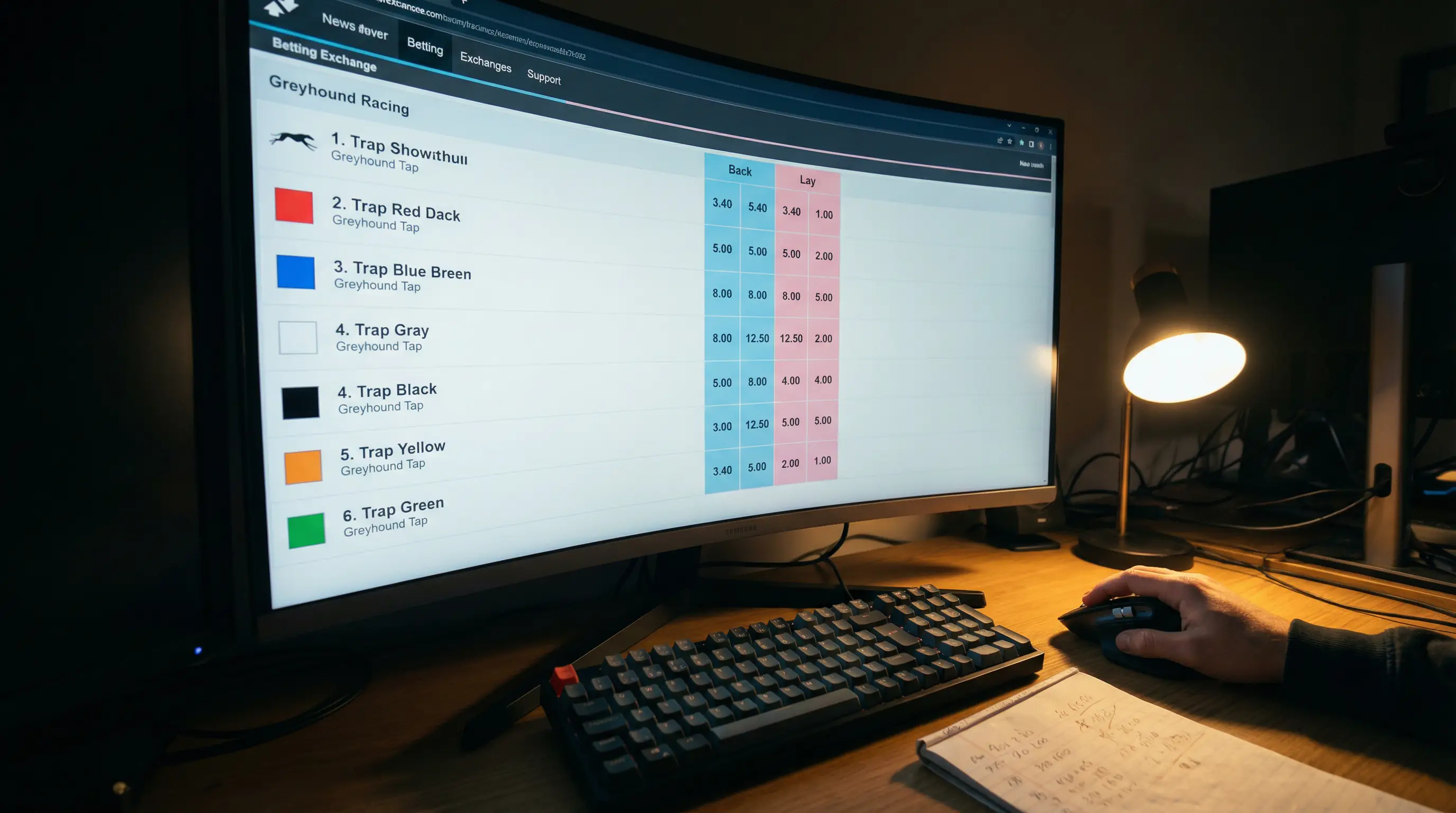
The exchange displays both the back price and the lay price simultaneously. The gap between them — the spread — is the exchange equivalent of the bookmaker’s margin, except it’s set by the market rather than by a pricing team. On popular greyhound races with good liquidity, the spread might be as tight as one tick (e.g., 3.40 to back, 3.45 to lay). On less liquid markets, the spread can be wider, reflecting the thinner pool of users willing to take each side.
Liquidity is the practical limitation of exchange greyhound betting. Horse racing exchanges attract deep pools of money, with tens of thousands matched on major races. Greyhound exchanges are thinner. A standard BAGS race might have only a few hundred pounds matched across the field before the off, and some runners may have minimal or zero liquidity. This means you can’t always get your desired stake matched at the price you want, particularly on longer-priced runners or less popular meetings.
Trading Greyhound Markets: Pre-Race and In-Play
Trading is the practice of backing at one price and laying at another to lock in a profit (or cut a loss) regardless of the result. It’s how exchange professionals approach the market, and while greyhound trading is more challenging than horse racing due to lower liquidity and shorter race durations, it’s a viable strategy for punters who understand market dynamics.
Pre-race trading works like this. You back a greyhound at 5.0 for £20. The price shortens as money comes in, and the dog is now available to lay at 4.0. You lay it at 4.0 for £25 (calculated to equalise your position). Regardless of whether the dog wins or loses, you’ve locked in a profit from the price movement. The arithmetic depends on the specific back and lay prices and stakes, but the principle is consistent: back high, lay low, and the difference is your profit.
In-play trading on greyhound races is technically possible but extremely demanding. Greyhound races last between 16 and 35 seconds depending on the distance. The in-play market operates for most of that duration on exchanges, but the speed at which prices change — a dog leading at the first bend might be 1.10 to lay, while the same dog trailing is 20.0 within seconds — makes execution difficult. Latency matters. A fraction of a second’s delay in placing a trade can mean the price has moved several ticks against you.
For most punters, pre-race trading is the accessible form. Watch the market in the fifteen to twenty minutes before the off. Identify dogs whose prices are moving (shortening or drifting) and take a position early if you believe the direction will continue. Exchange markets for greyhounds tend to follow the bookmaker market with a slight delay, so watching bookmaker price movements can give you an early signal of where the exchange price is heading.
The risk in trading is that prices don’t move in the direction you expected. If you back at 5.0 and the price drifts to 6.0 instead of shortening, you’re left with a losing position unless the dog wins. You can lay at 6.0 to close the trade at a loss, or you can hold the back bet and hope the dog wins. Both options involve risk, and neither is inherently better — it depends on your assessment of the dog’s actual chance and whether the price drift reflects new information or simply a thin market fluctuating.
Exchange vs Bookmaker: When Each Makes Sense
The exchange doesn’t always offer better value than a bookmaker. It depends on the race, the runner, and the specific market conditions. Understanding when to use each channel is a practical skill that can improve your overall returns.
Exchanges tend to offer better back prices on favourites and second favourites. These are the runners with the most exchange liquidity, and the competitive market between backers and layers often drives the price above what bookmakers offer. If the bookmaker price on a 2/1 favourite is 3.0 in decimal, the exchange back price might be 3.10 or 3.15. Over hundreds of bets on favourites, that extra 0.10-0.15 in decimal adds up to significant additional returns.
Bookmakers tend to offer better value on outsiders. Exchange liquidity on longer-priced greyhounds is thin, and the spread between back and lay prices can be wide. A bookmaker might offer 8/1 (9.0 decimal) on a 10/1 outsider while the exchange has nothing available to back above 7.0. In this case, the bookmaker is the better option purely on price.
The exchange’s unique advantage is the ability to lay. No traditional bookmaker lets you bet against a specific dog. If your form analysis tells you that the favourite is vulnerable — overpriced by the market, poor trap draw, wrong conditions — laying on the exchange lets you profit from that opinion without needing to identify the winner. You just need the favourite to lose, which in a six-dog field happens roughly 65-70% of the time for a typical favourite. Laying is an entirely different way of expressing a view on a race, and it’s exclusive to exchanges.
Commission is the exchange’s cost of doing business. Most exchanges charge 2-5% on net winnings, which reduces your effective odds on every winning bet. Factor this into any price comparison. An exchange price of 3.20 with 5% commission gives you an effective return of approximately 3.09 — which might still beat the bookmaker’s 3.0, but the margin is thinner than the raw price suggests.
Exchanges Are a Different Market — Learn the Rules Before You Play
The exchange isn’t inherently better or worse than a traditional bookmaker. It’s a different market structure with different strengths: better favourite prices, the ability to lay, trading opportunities, and a commission-based model that rewards consistent winners rather than penalising them. Its weaknesses — lower liquidity on greyhound racing, wider spreads on outsiders, and the complexity of managing lay liability — are real constraints that affect how you use it.
The practical approach is to use both. Compare prices on every bet. Back with the bookmaker when the bookmaker is better. Back on the exchange when it offers superior odds. Lay on the exchange when your analysis identifies a vulnerable favourite. The punters who restrict themselves to one channel — exchange-only or bookmaker-only — are leaving value unclaimed on the other side.