How to Read a Greyhound Race Card
Best Greyhound Betting Sites – Bet on Greyhounds in 2026
Loading...
The Race Card Is Your Primary Tool — Learn to Use It
Every number printed on a greyhound race card is someone telling you something. The trap number tells you where the dog starts. The form figures tell you how it’s been running. The times tell you how fast. The weight tells you whether it’s lighter or heavier than last time. The trainer’s name tells you who’s preparing it. If you can read all of this fluently, you’re making informed decisions. If you’re guessing around the numbers, you’re guessing with your money.
Greyhound race cards carry less information than horse racing equivalents — there are no jockeys, no draw sections, no going descriptions in the same sense — but what they do carry is dense and directly relevant to the outcome. Six lines of data, one per dog, and every column earns its space on the card. This article walks through each column, explains what it means, and shows you how the pieces fit together into a coherent picture of a race before the traps open.
Whether you’re looking at a card in a betting shop, on a bookmaker’s website, or through a dedicated racing data provider, the core layout is consistent. Column names and ordering may vary slightly between platforms, but the information categories are standardised across UK greyhound racing.
Column by Column: What the Race Card Shows You
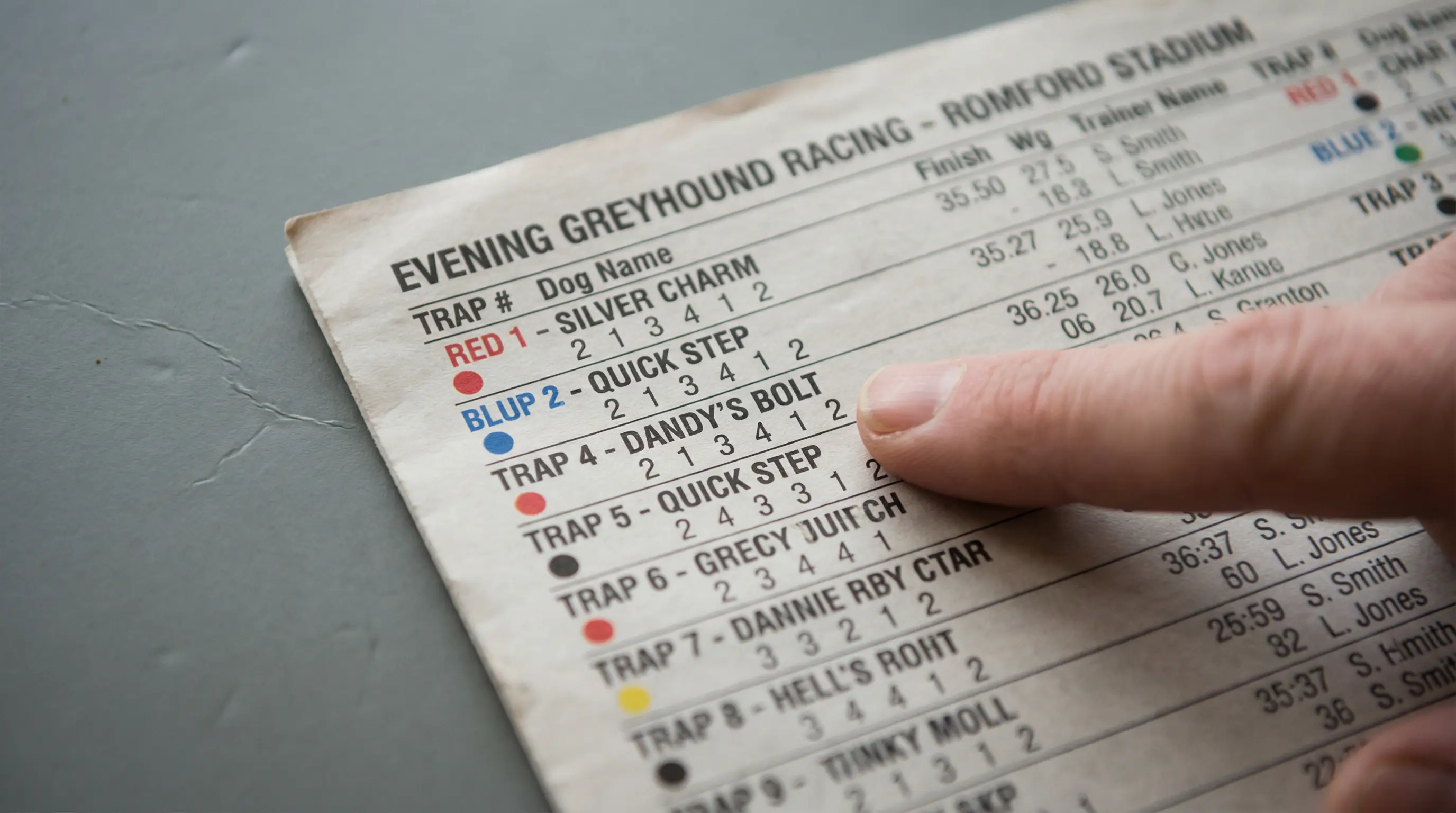
Start at the left and work right. The first column is the trap number — 1 through 6 — which corresponds to the starting position and jacket colour. Trap 1 is red, trap 2 is blue, trap 3 is white, trap 4 is black, trap 5 is orange, and trap 6 is black and white stripes. These colours are universal across all GBGB-licensed tracks and are the easiest way to follow your dog during the race. If a reserve runner replaces a declared dog, the reserve takes the vacant trap number and wears the corresponding jacket.
Next comes the dog’s name, usually accompanied by its breeding details — sire and dam — and the owner’s name. The breeding information is useful for punters who follow bloodlines, but for most race card reading purposes, the name is primarily an identifier.
The form string follows. This is the most information-dense element on the card. It typically shows the finishing positions from the dog’s last six races, read from left to right in chronological order (oldest run first, most recent last). A string reading “3 2 1 4 1 2” tells you the dog finished third, then second, then won, then fourth, then won again, and most recently finished second. The trend here is as important as the individual numbers: consistency, improvement, or decline all show up in the sequence.
Within the form string, you’ll also encounter letters. “D” indicates disqualification. “F” means the dog fell during the race. “T” denotes a trial rather than a competitive race. A dash or hyphen typically separates different periods, such as a break between racing seasons. Some cards use “M” for a moved-out-of-grade run or “R” for a reserves race. These letters interrupt the numerical sequence and provide context that raw finishing positions alone don’t capture.
The times column shows the dog’s finishing time at this distance, usually expressed in seconds to two decimal places. A card might show “17.23” for a 280-metre race. Alongside this, many cards display the dog’s best recent time and sometimes a calculated or adjusted time that accounts for going or grade differences. Faster times at the same distance indicate better performance, but always compare times at the same track — surface and circuit differences make cross-track time comparisons unreliable.
Weight appears as a figure in kilograms, showing the dog’s weight at its most recent race or at the current meeting’s weigh-in. Weight changes between runs can signal fitness shifts. A dog carrying an extra kilogram might be returning from rest or carrying condition. A dog lighter than its last run might be sharper and race-fit, or it might be underweight due to illness. Context matters — the direction and magnitude of the change, rather than the absolute number, is what to focus on.
The trainer’s name and kennel are listed, usually abbreviated. Some cards also include the trainer’s recent strike rate — the percentage of their runners that have won over a specified period. Trainer form is an underused data point. A trainer running at a 25% win rate over the past month is in better form than one at 10%, and at tracks where certain trainers have historically strong records, the name alone can be relevant.
Finally, many cards include a comment or analyst’s verdict — a short line summarising the dog’s prospects. This might read “fast early, should lead” or “needs to find more at this grade” or simply “each-way chance.” Comments are starting points, not conclusions. They represent one analyst’s reading of the form, and they’re worth noting but not treating as definitive.
Common Race Card Abbreviations
Greyhound race cards use a compact set of abbreviations that, once learned, decode instantly. The most frequently encountered ones relate to the form string, race conditions, and performance indicators.
In form: “1” through “6” are finishing positions. “D” is disqualification (usually for interference). “F” is a fall. “T” is a trial run. “SP” after a time indicates a Starting Price reference. “Bk” means the dog was bumped during the race. “Ck” means checked — the dog had to change course to avoid another runner. “SAw” means slow away, indicating the dog was slow leaving the traps. “W” indicates a wide run, and “Rls” means rails — the dog ran the inside line.
For race type: “A1” through “A11” (or equivalent) indicate the grade. “OR” means Open Race — a non-graded race accepting entries from any class. “H” designates a handicap race, where dogs start from staggered positions. “P” can mean a puppy race or a provisional entry depending on context.
Time and distance: “ct” stands for calculated time (an adjusted figure). “bst” or “BT” is best time. “w” following a time indicates a wide run, meaning the dog covered more ground than the standard distance. Distance markers like “280m” or “480m” are self-explanatory, but note that distances vary between tracks — a 480-metre race at one venue is not identical to a 480-metre race at another due to differing bend configurations.
If the card shows “res” beside a trap, the dog is a reserve — a replacement runner who will take the trap of any withdrawn dog. Reserves typically appear at the bottom of the card and only run if a declared runner is withdrawn before the race.
Putting It Together: Reading a Race in Practice
A race card only becomes useful when you read it as a connected narrative rather than a set of isolated numbers. The form string tells you the trend. The times tell you the level. The trap draw tells you the positional context. The weight tells you the fitness signal. The trainer tells you the human factor. Each column answers a different question, and the combination of answers builds a picture of each dog’s prospects.
Start with the form. Identify dogs with improving sequences — strings that show lower finishing positions in recent runs (remembering that 1 is best). A form string ending “3 2 1” is a dog on the upgrade. One ending “1 2 4” is potentially declining. Look for consistency too: a dog that runs “2 2 1 2 1 2” is reliably competitive even if it doesn’t always win.
Then check the times against each other. The fastest recent time at this distance is the dog with the highest ceiling, but consistency of times matters more than a single standout figure. A dog that runs 17.20, 17.25, 17.18, and 17.22 is more predictable than one that runs 16.90, 17.50, 17.30, and 17.10. The first dog is marginally slower at its peak but far more reliable — and reliability is what you’re paying for at the bookmaker’s prices.
Factor in the trap draw. A dog with improving form drawn in a statistically favourable trap at this track has two advantages working in concert. A dog with strong times but a poor trap draw faces a structural headwind. Neither factor is absolute, but together they tilt the probability assessment.
Check for any flags in the form that explain anomalies. A recent “F” (fall) or “Ck” (checked) means the dog’s last finishing position might not represent its true ability. A dog that was checked at the first bend and still finished third might have won with a clear run. These are the details that separate punters who read cards from punters who glance at them.
Read the Card, Then Read It Again
The race card rewards attention. A first pass gives you the headline data — form trends, fastest times, trainer names. A second pass reveals the subtleties: the checked run that explains a poor position, the weight drop that signals renewed fitness, the trap switch that gives a wide runner the inside draw it’s been missing. Most punters read the card once, if at all. The punters who read it twice have a structural advantage — not because the data changes, but because their understanding of it deepens.