Greyhound Running Styles and Track Position
Best Greyhound Betting Sites – Bet on Greyhounds in 2026
Loading...
How a Dog Runs Matters as Much as How Fast It Runs
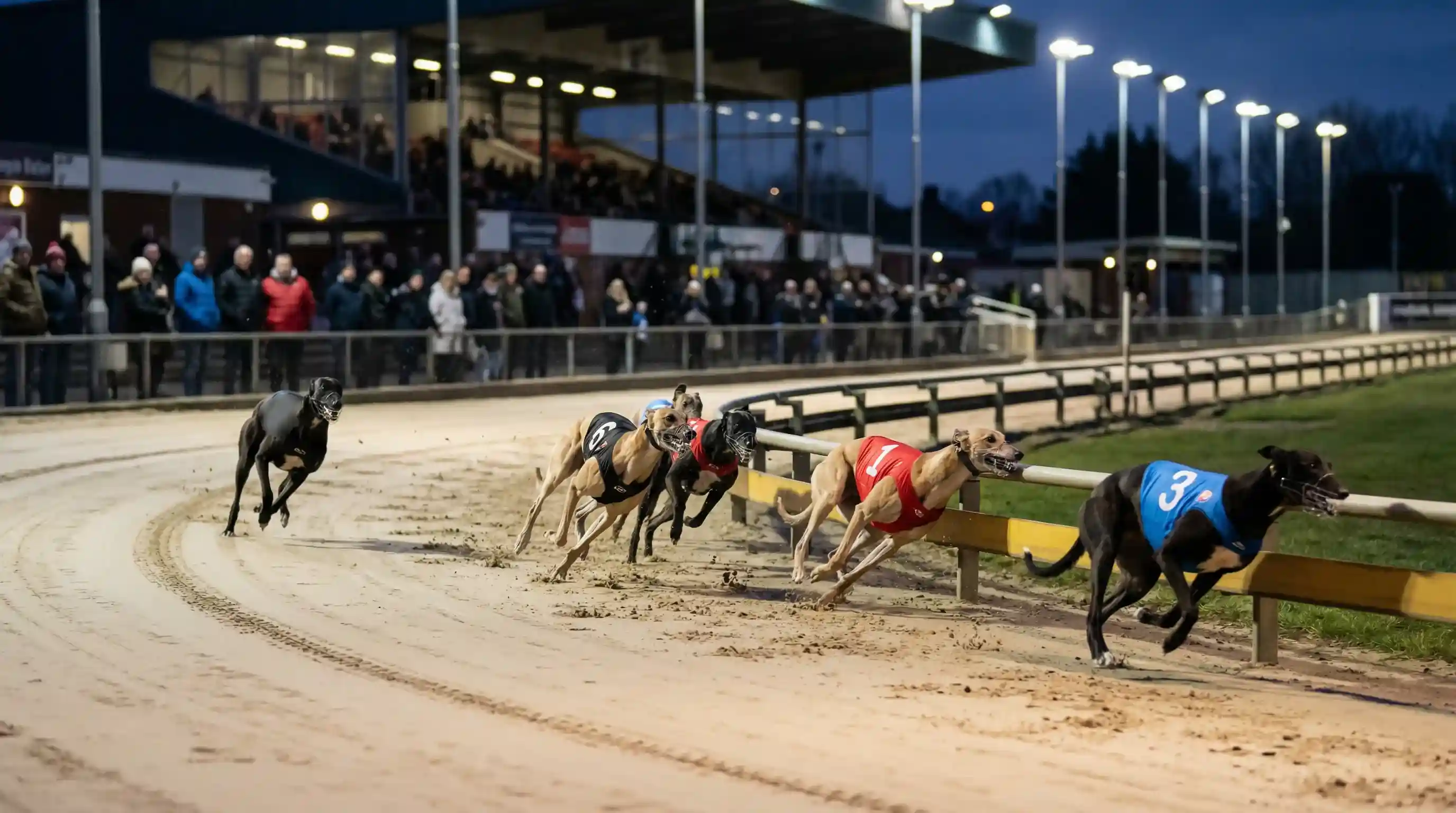
Two greyhounds can post identical times over 480 metres and be completely different animals in competitive terms. One hugs the inside rail from break to finish, covering the minimum possible distance. The other swings wide around every bend, running perhaps ten metres further in the same race but finishing in the same time because its raw speed is superior. Put those two dogs in the same race and the outcome depends not just on their speed but on the trap draw, the track geometry, and the positions of the other four dogs in the field.
Running style is a fundamental characteristic of every greyhound, as ingrained as its pace or stamina. Some dogs are born railers — they instinctively seek the inside line and follow the rail around every bend. Others run naturally wide, taking a sweeping path that avoids inside traffic but adds distance. Some are front-runners that lead from the traps. Others are closers that sit behind the pace and finish strongly. These tendencies are visible in the form data, predictable from race to race, and directly relevant to how you assess a dog’s chance in any given race.
Understanding running styles turns race reading from a simple speed comparison into a spatial exercise. You’re not just asking which dog is fastest. You’re asking how six different running styles will interact around two or four bends on a specific track, from specific starting positions.
The Four Running Style Categories
Greyhound running styles fall into four broad categories, though many dogs blend elements of more than one. The labels vary between commentators and data providers, but the underlying behaviours are consistent.
Leaders break fast from the traps and aim to reach the first bend in front. They’re typically dogs with explosive early pace — a first-sectional time that’s measurably quicker than their rivals. Leaders win by controlling the race from the front, avoiding the interference that occurs behind them, and maintaining enough speed to hold off any challenges in the closing stages. Their vulnerability is clear: if they don’t lead, they often struggle. Dogs that need the front are one-dimensional, and when another dog beats them to the bend, they can lose focus and finish weakly.
Railers are dogs that run tight to the inside rail regardless of whether they lead or not. A railer might break second or third from the traps but will work its way to the inside line and stick there through every bend. The advantage is distance: the rail is the shortest route around the track. The disadvantage is traffic. The rail is where the congestion happens, and a railer can get boxed in behind slower dogs with no room to move out. Race cards and form comments often flag railers with notations like “Rls” (rails) or descriptions such as “always rails.”
Wide runners take the opposite approach. They swing away from the rail on the bends, running a wider arc that adds distance but provides cleaner racing room. Wide runners are often dogs with strong finishing speed who can afford the extra ground because their pace through the bends compensates for the longer path. They’re less susceptible to interference but more dependent on raw speed to overcome the distance penalty. Cards flag wide runners with “W” or comments like “runs wide” or “needs room.”
Closers — sometimes called finishers — are defined by their race position rather than their rail preference. They sit toward the back of the field in the early stages and rely on superior late speed to overhaul the leaders in the final straight. A closer might be a railer or a wide runner; the defining characteristic is the late burst rather than the path taken. Closers need the race to be run at a pace that brings the leaders back to them, and they need enough straight after the final bend to close the gap. On tracks with short home straights, closers are structurally disadvantaged.
Rail Position: Why Inside and Outside Are Not Equal
The inside rail is the shortest path around a greyhound track. On a standard four-bend circuit, the distance difference between running tight to the rail and running two metres wide is roughly eight to twelve metres over the full race distance. At racing speed, that translates to approximately 0.3-0.5 seconds — which is the margin between first and third in many graded races.
This distance advantage makes the rail the most valuable real estate on the track, and it’s why railers drawn in inside traps enjoy a measurable statistical edge. A railer from trap 1 can break, hit the rail immediately, and run the shortest possible route with no transition. A railer from trap 4 needs to cross three lanes of traffic to reach the rail, and by the time it gets there, the trap 1 dog is already established on the inside line.
Wide running isn’t purely disadvantageous, though. At tracks where the inside bends are tight and the rail is not perfectly smooth, running wide avoids the deceleration that rail runners experience through sharp turns. Some tracks have a measurable wide bias on certain bends — the running surface is faster two metres off the rail than on it, possibly due to sand depth, camber, or drainage patterns. At these venues, the wide runner’s extra distance is partially compensated by superior surface speed.
The interaction between running style and track geometry creates specific tactical patterns. At a track with a long home straight, closers have more room to finish. At a track with sharp bends and a short straight, front-runners and railers dominate because there’s nowhere for closers to make up ground. At a track with a wide, sweeping circuit, the rail advantage is reduced and wide runners compete on more equal terms. Every track has a personality, and running styles that suit that personality outperform those that don’t.
Weather and surface conditions alter the rail equation as well. After heavy rain, the rail can become softer and slower as water drains toward the inside of the track. Dogs that normally rail may find the going heavier on their preferred line, while wide runners hit firmer ground. This is a temporary effect, but on wet evenings it can shift the race dynamics enough to change the result.
Matching Running Style to Trap Draw
The best betting opportunities in greyhound racing often come from the intersection of running style and trap draw. When a dog’s natural running preference aligns with its starting position, it runs its race without compromise. When the two conflict, the dog either adjusts — often unsuccessfully — or runs its natural style from an unfavourable position, covering extra ground or encountering traffic it would normally avoid.
The ideal combinations are straightforward. Railers benefit from inside traps (1 and 2). Wide runners benefit from outside traps (5 and 6). This alignment is formalised through the GBGB’s seeding system, which assigns railers to lower-numbered traps and wide runners to higher-numbered traps in graded races. Leaders benefit from any trap that gives them a clear path to the first bend, which usually means traps 1 or 6 where they can break without being squeezed by dogs on both sides. Closers are less trap-dependent because their race is determined by what happens after the first bend, but they prefer draws that keep them out of the early scrimmaging.
The worst combinations are equally predictable. A confirmed railer drawn in trap 6 must cross the entire field to reach the rail — and by the time it gets there, it’s used energy, lost position, and possibly interfered with other runners. A wide runner drawn in trap 1 faces a choice: run unnaturally on the rail or swing wide from the inside, losing ground to dogs that are already on its outside. Neither option is ideal.
These mismatches create value in the market. When a dog with strong form is drawn in a trap that conflicts with its running style, its price often drifts slightly — but sometimes not enough to reflect the genuine disadvantage. Conversely, when a moderate dog gets the perfect style-trap alignment, its price may not shorten enough to reflect the boost. Reading the race card for style-trap fit is a quick assessment that can identify situations where the market has mispriced the positional dynamics.
Form comments and sectional data both help identify running style. If the card notes “always rails” or the dog’s runs consistently show tight inside sectionals, it’s a railer. If the card notes “runs wide” or the dog’s overall time is fast despite moderate positional finishes, it may be covering extra ground on the outside. Combine this with trap statistics for the specific track, and you have a layered assessment that goes well beyond raw form figures.
The Race Is a Spatial Problem — Solve It Spatially
Speed matters. Form matters. But the spatial dimension — where on the track each dog wants to be, where it starts, and how six different running preferences interact through the bends — is what turns a set of form figures into a race prediction. Dogs don’t run in lanes. They jostle, crowd, bump, and adjust from the moment the traps open. The punters who visualise that process, rather than simply comparing times, are the ones who see outcomes the market doesn’t price.
Before your next bet, sketch the race in your head. Where does each dog want to be at the first bend? Who gets there first? Who gets blocked? Who has clean air? The answers don’t guarantee a winner, but they guarantee a better understanding of why the winner won — and that understanding is what makes the next bet sharper.