Greyhound Sectional Times
Best Greyhound Betting Sites – Bet on Greyhounds in 2026
Loading...
Overall Time Tells You the Result — Sectionals Tell You the Race
A dog that runs 17.10 over 280 metres and a dog that also runs 17.10 over 280 metres are not the same proposition. One might have clocked 3.90 to the first bend and hung on. The other might have run 4.15 to the bend and finished like a train. Their overall times are identical. Their racing profiles are completely different. Sectional times — the split data that breaks a race into segments — reveal those differences, and understanding them changes how you assess form.
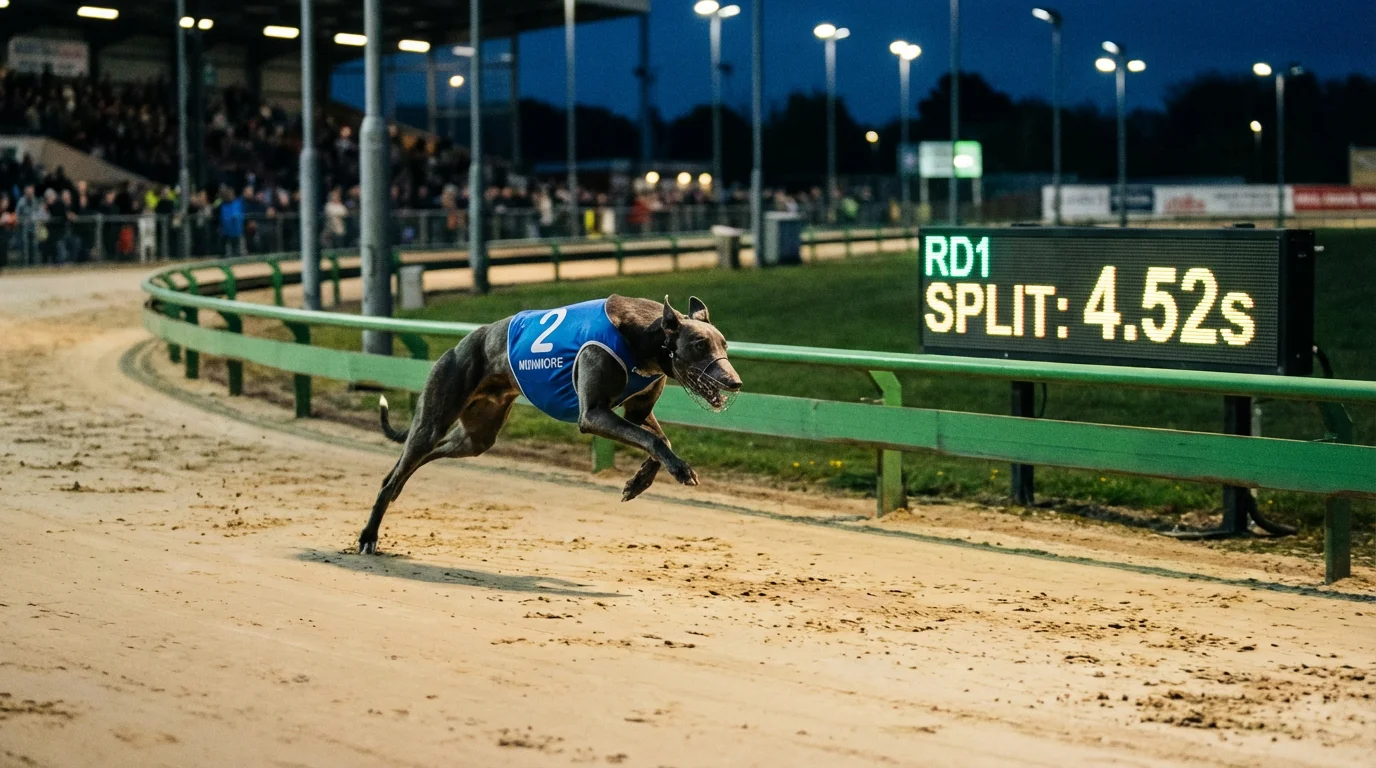
In greyhound racing, sectionals are typically measured to the first bend and then from the first bend to the finishing line, though some tracks and data providers offer more granular breakdowns. The time to the first bend is the critical number. It determines which dogs are likely to lead, which will be fighting for position in the pack, and which will be relying on late speed to make up ground. Every race unfolds from that opening split, and the dogs that get to the bend quickest control what happens next.
Sectional data isn’t available for every meeting at every track, but where it is published — through data providers and some racecard services — it transforms a one-dimensional time figure into a two-dimensional race profile. And that extra dimension is where the edge lives.
What Sectional Times Reveal About a Dog’s Running Profile
The first sectional — time to the first bend — is the single most predictive piece of timing data in greyhound racing. A dog that consistently runs 3.85-3.90 to the bend at a given track is a confirmed front-runner. It will be at or near the lead when the field hits the first turn. A dog running 4.10-4.20 to the same bend is a midfield or slow-beginning type. It’s conceding ground early and relying on superior speed through the bends and down the straights to close the gap.
Neither profile is inherently better. Front-runners win by controlling the race from the front, avoiding interference, and maintaining their pace. Closers win by staying out of trouble in the early exchanges and finishing faster than the dogs that led. The question for betting purposes isn’t which style wins more often in the abstract — it’s which style is suited to a specific race, at a specific track, from a specific trap draw.
A front-runner drawn in trap 1 at a track with a short run to the first bend has the ideal setup: inside rail position, a quick path to the bend, and the ability to dictate pace from the front. The same dog drawn in trap 5 at the same track faces a longer path to the rail and the possibility of being crowded by inside-drawn dogs at the bend. Its sectional time to the bend might be similar, but the positional outcome will differ.
Conversely, a closer drawn wide can benefit from a clean racing line if the inside dogs tangle at the first bend. The closer’s sectional to the bend will be slower, but if it picks up ground through the second half of the race — indicated by a faster second sectional — the wide draw may actually work in its favour by keeping it away from early interference.
The second sectional — from the first bend to the finish — measures finishing speed. Dogs with fast second sectionals and slower first sectionals are closers. Dogs with fast first sectionals and slower second sectionals are front-runners who fade. Dogs with fast times in both splits are the genuinely class animals — they lead and sustain. These dogs tend to be shorter in the market because their overall times are fastest, but comparing their sectionals against their rivals often reveals whether the market has priced them accurately.
Comparing Splits: How to Spot Mismatches and Opportunities
The real analytical power of sectionals comes from comparison. Looking at a single dog’s splits tells you its profile. Looking at all six dogs’ splits tells you how the race is likely to unfold — and whether the market has anticipated that unfolding correctly.
Start by ranking the six dogs in a race by their first sectional time at this track and distance. The two or three fastest to the bend are your likely leaders. If two of those dogs are drawn in adjacent inside traps, expect them to contest the lead into the first bend — and expect potential crowding that could compromise both. If one clear leader has a significantly faster first sectional than the rest, that dog has a pace advantage that could translate to an uncontested lead, which is the most advantageous position in greyhound racing.
Now look at the dogs with slower first sectionals but faster second sectionals. These are the closers. If the pace is strong — two fast dogs contesting the lead — the closers benefit because the leaders may tire or interfere with each other. If the pace is weak — one moderate front-runner with no pressure — the closers face a harder task because the leader conserves energy and maintains its advantage.
The mismatch opportunity arises when the market hasn’t accounted for pace dynamics. A common scenario: the form favourite has the fastest overall time but achieves it through a moderate first sectional and a very fast second sectional. It’s a closer. The second favourite is a front-runner with a faster first sectional but slower overall time. In a race with no other genuine front-runners, the second favourite might lead unchallenged and hold on, despite having the slower overall figure. The market, anchored to overall times, may underrate this possibility.
Cross-track comparison of sectionals requires caution. A 3.90 first sectional at one track is not equivalent to 3.90 at another — track dimensions, trap placement, and surface speed all differ. Always compare sectionals within the same track and distance. If a dog is racing at a new venue, its sectionals from a different track are a rough guide at best.
Applying Sectional Data to Betting Decisions
Sectionals feed into betting in three specific ways. First, they help you assess whether a dog’s recent form figure accurately represents its ability. A dog that finished fourth but was checked at the first bend (losing perhaps 0.2 seconds in the first sectional) might have run a faster true race than the dog that won unchallenged. Sectionals quantify that interference and let you estimate what the dog would have run with a clear passage.
Second, sectionals help you identify improving dogs before the market catches up. A dog that has been consistently running 4.10 to the first bend but posted 4.00 in its last run is showing improved early pace. That improvement may not yet be reflected in its finishing position — it might still have finished third because the improvement came late in the race — but the sectional data flags it as one to watch. If the improvement carries into the next race, the dog’s odds may still reflect its older, slower profile.
Third, sectionals enable you to model race scenarios. If you know the first sectionals of all six dogs, you can sketch out the probable first-bend order: who leads, who sits midfield, who trails. From there, you can assess which dogs are likely to have clear running and which might face trouble. A dog with strong finishing speed but slow early pace needs the race to unfold in a way that gives it room to close. If three front-runners are drawn inside it, the early pace may be chaotic enough to create gaps. If only one moderate leader is in the race, that dog might control the tempo and the closer never gets close enough.
None of this is guaranteed prediction. Dogs break differently from race to race, and interference at the first bend is inherently unpredictable. But sectional analysis shifts you from reacting to results toward anticipating how results are produced. That shift — from backward-looking to forward-looking — is where form reading becomes genuinely useful for betting.
The Splits Don’t Lie — But They Don’t Tell the Whole Truth
Sectional times are the most analytically useful data point in greyhound racing after overall form. They tell you how a dog runs, not just how fast. They reveal pace profiles, positional advantages, and the hidden interference that finishing positions don’t capture. They’re also incomplete. They don’t measure a dog’s temperament, its response to pressure from another runner, or its behaviour in crowded fields. Use them as the sharpest tool in your analytical kit — but keep the other tools within reach.