In-Play Greyhound Betting
Best Greyhound Betting Sites – Bet on Greyhounds in 2026
Loading...
Thirty Seconds of Chaos: What In-Play Greyhound Betting Looks Like
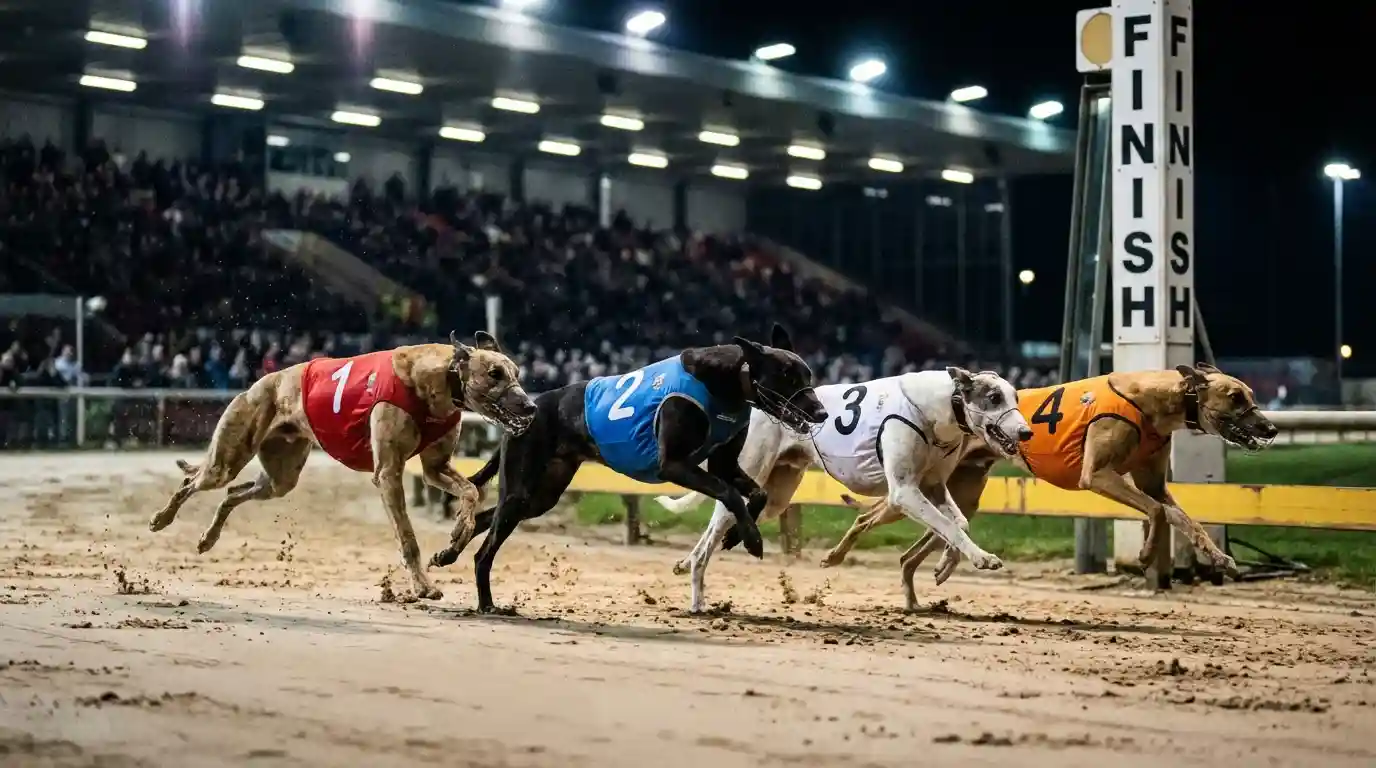
In-play betting on greyhound racing is the fastest live betting market in any sport. A typical race lasts somewhere between 16 and 35 seconds depending on the distance, and the odds change with every stride. The dog leading at the first bend might be trading at 1.05 on the exchange. Two seconds later, after being bumped wide at the second bend, it could be 5.0. The entire market reprices itself multiple times during a race that’s over before a footballer has time to take a corner kick.
This speed creates a market that is genuinely different from pre-race betting. Pre-race, you have time to study form, compare prices, and make considered decisions. In-play, you’re reacting to what you see in real time, placing bets while the outcome is unfolding, and trusting your ability to process visual information faster than the market adjusts. It’s exciting. It’s also extremely difficult to do profitably, and any honest assessment of in-play greyhound betting has to start with that reality.
How In-Play Greyhound Betting Works
Most major UK bookmakers offer in-play betting on greyhound racing, and the leading betting exchanges keep their markets open throughout the race. The mechanisms differ between the two.
At bookmakers, in-play greyhound betting typically operates through a “bet in-play” function that becomes active when the traps open. The odds displayed update dynamically, reflecting the bookmaker’s real-time assessment of each dog’s winning probability based on its position in the race. You select a dog and request a bet at the current price, but there’s a delay — the bookmaker takes a moment to confirm the bet, during which the price may change. If the price moves against you during the delay, the bet may be rejected or offered at the new price. This time-lag protection exists because the bookmaker knows the market is moving faster than the interface can display.
On exchanges, in-play betting is more fluid. Back and lay prices update continuously based on what other users are offering, and bets are matched instantly when the prices cross. However, exchange in-play greyhound markets can be extremely thin. A race might have only a few hundred pounds matched across all six dogs during the entire running, and the prices can jump in large increments rather than moving smoothly. A dog that was 3.0 before the first bend might show 1.50 or 8.0 at the bend depending on its position, with little available to bet at any price in between.
Live streaming is a prerequisite for in-play greyhound betting. Without watching the race in real time, you’re betting blind — the odds alone don’t tell you whether a dog is running smoothly in second or struggling to hold its position under pressure. Most major bookmakers offer live streams of BAGS and BEGS meetings through their platforms, and you need a funded account or a recently placed bet to access the stream. The stream delay — typically one to three seconds behind the actual race — is another factor. You’re watching what happened a moment ago, not what’s happening now, and the market is priced to the actual race, not the delayed stream.
The Speed Problem: Why Greyhound In-Play Is Uniquely Difficult
Horse racing in-play markets operate over two to five minutes. You have time to watch the pace, assess position changes, wait for the home straight, and place a bet with relative deliberation. Greyhound in-play operates over a fraction of that time. The entire race — from traps to finish — can be done in under twenty seconds for a sprint. There is no equivalent in mainstream sports betting.
This compression creates three specific challenges. First, your processing time is minimal. You need to watch the race, assess positions, decide on a bet, and execute it within a window of perhaps five to ten seconds. Most punters can’t do this reliably, and the punters who can are often using automated tools or algorithms that react faster than a human watching a stream can.
Second, the stream delay means you’re always behind the market. If you see a dog take the lead at the first bend and decide to back it, the exchange price has already shortened to reflect that lead. By the time your bet is placed and matched, the price may have moved further still. You’re systematically buying at a worse price than the real-time position justifies, and that systematic disadvantage compounds over many bets.
Third, the information content of in-play greyhound betting is low compared to the speed at which decisions must be made. In a horse race, you can observe pace, position, jockey effort, and closing speed over two or more minutes, building a picture of how the race will finish. In a greyhound race, the dogs are running flat out from the traps. There’s no pacing, no tactical riding, and very little observable difference between a dog that will hold its position and one that’s about to fade — at least not at the speed the race occurs.
Is There Value in Running? Honest Assessment
The promotional pitch for in-play greyhound betting is appealing: watch the race develop, bet when you can see what’s happening, and react to events as they unfold. The reality is more nuanced. Value in-play exists, but it’s concentrated in specific situations and is far harder to capture than pre-race value.
The clearest in-play opportunity is the first-bend scenario. If the pre-race favourite is slow away and hits the first bend in fourth or fifth, its in-play price will lengthen sharply. If you believe the favourite has the class and finishing speed to recover — perhaps it’s a known closer that regularly runs from behind — the lengthened price may overstate the impact of its poor start. This is a genuine mispricing that occurs because the in-play market reacts to position rather than to the dog’s remaining potential.
Similarly, if a race develops into chaos at the first bend — multiple dogs checking, one falling — the entire market reprices dramatically, and the dog that emerges in front may be available at odds that don’t reflect its new, clearer path to the finish. These moments are where in-play value concentrates: sudden, race-specific events that the market overreacts to in the immediate aftermath.
The problem is execution. These opportunities last for fractions of a second. By the time you’ve recognised the scenario, assessed the value, and attempted to place a bet, the market has already corrected. Professional in-play bettors on greyhound exchanges use pre-set strategies and fast execution, often backed by software that monitors prices and triggers bets automatically. Manual in-play betting — watching a stream and clicking a button — is bringing a knife to a gunfight in terms of speed and precision.
For the typical punter, in-play greyhound betting is best approached as a small, speculative addition to a predominantly pre-race strategy. Use it when a specific race scenario creates an obvious mispricing that you can see and act on quickly. Don’t use it as a primary method, and don’t chase in-play bets because the first one didn’t land. The speed of the market means mistakes compound rapidly, and the absence of thinking time removes the analytical advantage that careful pre-race assessment provides.
Speed Kills Profits — Unless You’re Faster Than the Market
In-play greyhound betting is a product designed to generate engagement. It’s exciting, immediate, and visceral in a way that pre-race betting isn’t. Those qualities make it entertaining. They don’t make it profitable. The structural challenges — stream delay, minimal processing time, thin liquidity, and the information deficit of watching a race that lasts half a minute — stack against the manual punter.
If you bet in-play, do it selectively and with stakes you’d be comfortable losing on entertainment alone. The pre-race analysis you do — the form reading, the sectional assessment, the trap-draw analysis — is where your genuine edge exists. In-play betting asks you to abandon that edge and rely instead on reaction speed and real-time judgement, which is a trade most punters shouldn’t make.