What Does SP Mean in Greyhound Betting?
Best Greyhound Betting Sites – Bet on Greyhounds in 2026
Loading...
Starting Price: The Number That Decides Your Payout
SP is the odds your greyhound carries when the traps open — and it can be better or worse than the price you saw online three hours earlier. If you’ve ever placed a bet on a greyhound at “SP” rather than taking the quoted price, you’ve handed the final say on your payout to the on-course market. Sometimes that works in your favour. Sometimes it doesn’t. The difference between those outcomes comes down to understanding what SP actually is, how it’s formed, and when it serves you better than locking in a price early.
Starting Price is a UK betting tradition that dates back to the earliest days of organised dog racing. Before online bookmakers existed, before betting exchanges, and before you could get a price on your phone fifteen minutes before the off, the only way to determine a fair price for a runner was to look at what the on-course bookmakers were offering at the moment the race began. That price — the one the trackside market had settled on by the time the traps opened — became the Starting Price, and it remains the default payout price for any bet placed without a fixed odds selection.
In greyhound racing, SP plays a bigger role than many punters realise. Prices on dog racing can be volatile. A greyhound that opens at 4/1 in the morning market might go off at 7/2 or 9/2 depending on how the money flows in the hours and minutes before the race. If you bet at SP, you get whatever the market decides. If you took 4/1 early, you’re locked in at that price regardless of what happens later. That choice — take the price or wait for SP — is one of the most common practical decisions a greyhound punter faces.
How Starting Price Is Determined at UK Greyhound Tracks
An SP reporter watches the on-course bookmakers’ boards in the moments before the off and records the prevailing price. It’s a more structured process than most punters imagine, but it still relies on a surprisingly human system.
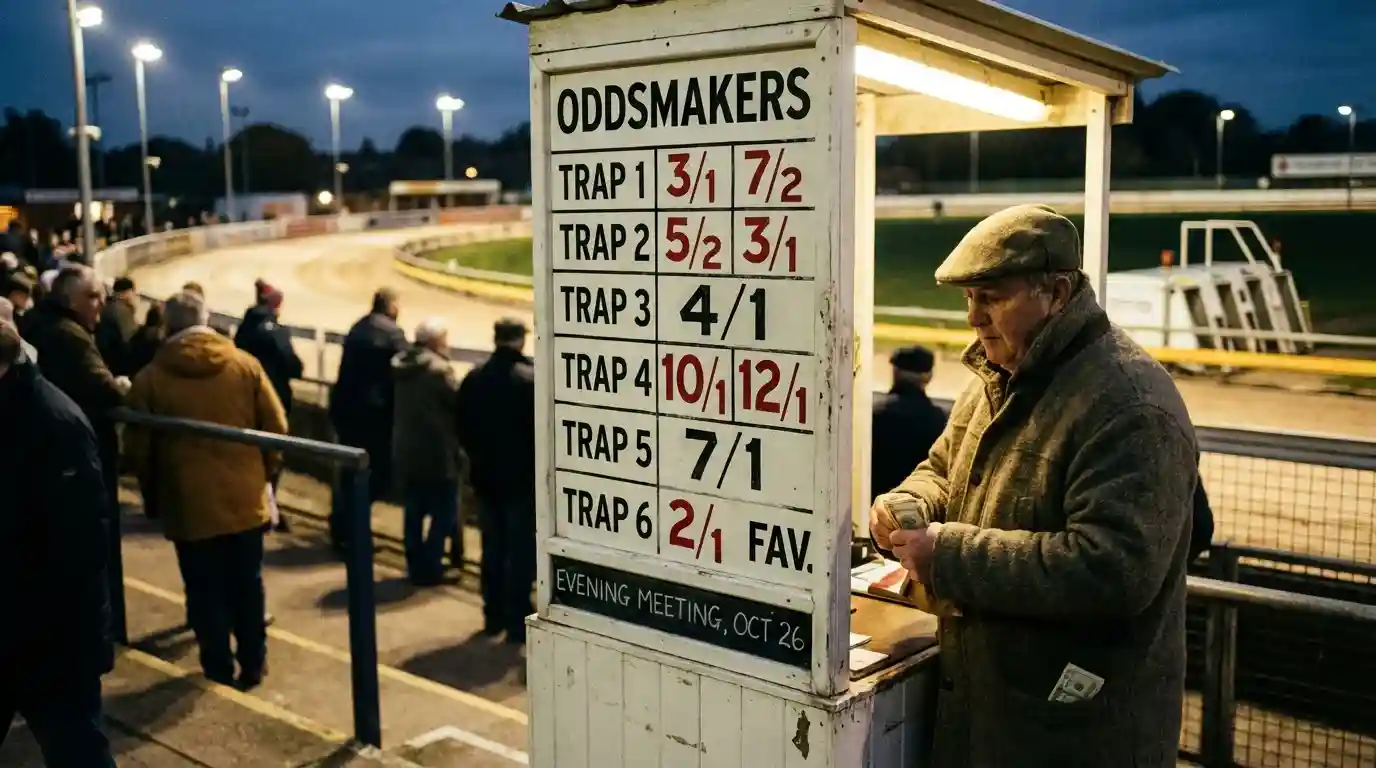
At GBGB-licensed greyhound tracks, on-course bookmakers set up their boards before each race and display prices for all six runners. These prices are driven by the bookmakers’ own form assessments, the money they’ve taken so far, and their need to balance the book. As punters at the track place bets, the bookmakers adjust their prices — shortening dogs that attract heavy money, drifting those that don’t. This process continues right up to the moment the hare starts and the traps are about to open.
The SP reporter — an independent official — records the prices displayed on the on-course boards at that final moment. The rules require the reporter to take a representative sample of the available prices, typically by surveying the majority of on-course bookmakers and determining the most common price offered. If three bookmakers show 3/1 and two show 7/2, the SP will likely be returned at 3/1. The reporter’s assessment becomes the official Starting Price, which is then used to settle all bets placed at SP through off-course bookmakers and online accounts.
For meetings without significant on-course betting — which includes many daytime BAGS fixtures where only a handful of trackside bookmakers operate — the SP can be more volatile because the on-course market is thinner. A single large bet at the track can shift the SP significantly. By contrast, at major open race nights with strong on-course attendance, the SP tends to be a more robust reflection of genuine market opinion.
It’s worth noting that the SP system for greyhounds operates under the same principles as horse racing, but the smaller fields and lower liquidity in greyhound markets mean that SP movements can be more dramatic. A horse racing market with twenty runners absorbs individual bets more easily than a six-dog greyhound market where one punter’s money can visibly move the price.
Taking the Price vs Waiting for SP: A Decision Framework
If you believe the dog will shorten — take the price. If you think money is coming against it — wait. That’s the core logic, but applying it requires some knowledge of how greyhound markets typically behave.
Early prices on greyhound races are usually available from mid-morning for afternoon BAGS meetings and from early afternoon for evening fixtures. These prices reflect the bookmaker’s opening assessment and are often more generous than the final SP, particularly for dogs with strong recent form that are likely to attract public money. If you’ve identified a dog with clear form claims and expect the wider punting public to back it as well, taking the early price gives you the best available number. Once the crowd money arrives, the price will shorten and SP will be lower than what you locked in.
The reverse scenario — waiting for SP to get a better price — works when you’re backing a dog the market doesn’t fancy but you do. If you believe a 5/2 shot is underrated and likely to drift as money goes elsewhere, waiting for SP could see you paid out at 7/2 or 4/1. This happens more often than you might think on dogs dropping in grade, switching distance, or running from an unfavourable trap that deters casual backers.
There’s also a middle-ground situation. Sometimes a dog opens at a fair price — not generous, not tight — and you genuinely don’t know which direction it will move. In these cases, Best Odds Guaranteed offers a safety net. If BOG is available for the meeting, you can take the early price knowing that if the SP drifts higher, you’ll be paid at the better price anyway.
A few practical patterns for greyhound markets specifically. Favourites in graded races tend to shorten from their opening price as the off approaches, particularly when the form is obvious. Second and third favourites are less predictable — they can shorten or drift depending on how much attention the favourite attracts. The two longest-priced runners in a six-dog field almost always drift from their opening price, as the weight of money in small markets gravitates toward the shorter-priced dogs.
Timing matters too. For afternoon BAGS racing, most price movement happens in the final thirty minutes before the race. For evening meetings with larger crowds, movement can start earlier and accelerate in the last ten minutes. If you’re planning to bet at SP, watching the market in those windows gives you a sense of whether you’d have been better off taking an earlier price.
Best Odds Guaranteed and Starting Price
BOG eliminates the dilemma — you get whichever is higher, the price you took or the SP. For greyhound punters, it’s one of the most useful promotions available, and it deserves attention whenever it’s offered.
Here’s how it works in practice. You back a greyhound at 3/1 in the morning. By the time the race goes off, the SP is returned at 4/1. With Best Odds Guaranteed, you’re paid out at 4/1 — the better of the two prices. If the SP had shortened to 5/2 instead, you’d still get your original 3/1. You win both ways.
The catch — and there is always a catch — is that BOG on greyhound racing is typically restricted to BAGS and BEGS meetings. These are the Bookmakers’ Afternoon Greyhound Service and Bookmakers’ Evening Greyhound Service fixtures, which make up the majority of daily greyhound racing in the UK. However, open race nights and some independent fixtures may not qualify. Always check the bookmaker’s terms. The difference between a meeting that qualifies for BOG and one that doesn’t can affect your entire approach to pricing.
Not all bookmakers offer BOG on greyhounds consistently. Some restrict it to new customers or specific promotional periods. Others — including several of the larger UK-facing firms — offer it as a standing policy on all qualifying meetings. If BOG is important to your approach, it’s worth maintaining accounts with the bookmakers who offer it reliably rather than assuming it’s universally available.
Know the Price Before You Pay It
SP isn’t a gamble within a gamble — it’s a tool. Used consciously, it works for you. Used by default, because you didn’t think about it, it works against you more often than it helps.
The punters who handle SP well are the ones who treat it as an active decision rather than a passive acceptance. They assess whether the current price is likely to shorten or drift. They check whether BOG is available for the meeting. They know the difference between a BAGS fixture where SP formation is thin and an open race night where the on-course market is robust. These aren’t advanced skills. They’re awareness, applied consistently.
Starting Price exists because the market needs a mechanism to settle bets that weren’t placed at a fixed number. For the bookmaker, it’s a necessary function. For you, it’s an option — and understanding when that option serves you is the difference between paying the right price and paying whatever the market hands you.