Track Conditions and Weather Impact on Greyhound Racing
Best Greyhound Betting Sites – Bet on Greyhounds in 2026
Loading...
The Surface Beneath Their Feet Changes the Race
Greyhound racing doesn’t have a going stick or an official ground description the way horse racing does, but make no mistake — track conditions vary meaningfully from meeting to meeting and sometimes from race to race within the same card. Rain alters the sand. Temperature affects grip. Wind changes the pace dynamics. These aren’t marginal effects that wash out over a season. They’re race-day variables that directly influence finishing times, running lines, and which dogs handle the conditions best.
Most punters check the form, the trap draw, and the price. Very few check the weather. That’s an oversight, because the conditions underfoot and overhead interact with everything else on the card. A front-runner that dominates on fast, dry sand may struggle on a wet, heavy surface that saps its early speed. A closer with a long stride might gain an advantage when the going is soft and the leaders tire earlier than usual. These patterns aren’t random. They’re repeatable, identifiable, and — if you pay attention — exploitable.
Sand Surfaces: Not All Tracks Run the Same
Every licensed greyhound track in the UK runs on sand, but the composition, depth, and maintenance regime vary between venues. The sand isn’t just a neutral backdrop — it’s the racing surface, and its characteristics affect speed, grip, and drainage in ways that change how each meeting plays.
Finer sand produces a faster surface. Dogs’ paws grip more evenly, and the deceleration through bends is less pronounced. Coarser sand offers more cushioning but produces slower times and demands more effort from the dogs, particularly through the turns where lateral grip matters. Tracks with well-maintained, consistently raked surfaces produce more predictable times from meeting to meeting. Tracks where the sand depth varies — deeper on the inside from drainage patterns, shallower on the racing line from wear — produce more variable conditions and wider performance fluctuations.
Sand depth is particularly relevant on the bends. Deeper sand slows the dogs more, and dogs that run tight to the rail on a track with deeper inside sand are at a greater disadvantage than on a track with uniform depth. This is one reason why some tracks show a wider-trap bias that doesn’t obviously correlate with their geometry — the surface quality varies across the width of the track, and dogs running different lines encounter different conditions.
Track maintenance between races also matters. Most tracks harrow the sand between races to level the surface and remove footprints. A freshly harrowed surface runs slightly differently from one that’s been compacted by several races — typically faster and more uniform. The first race on a card can sometimes produce slightly quicker times than mid-card races if the track was freshly prepared before the meeting, though the effect is modest and inconsistent.
Weather Effects: Rain, Wind, and Temperature
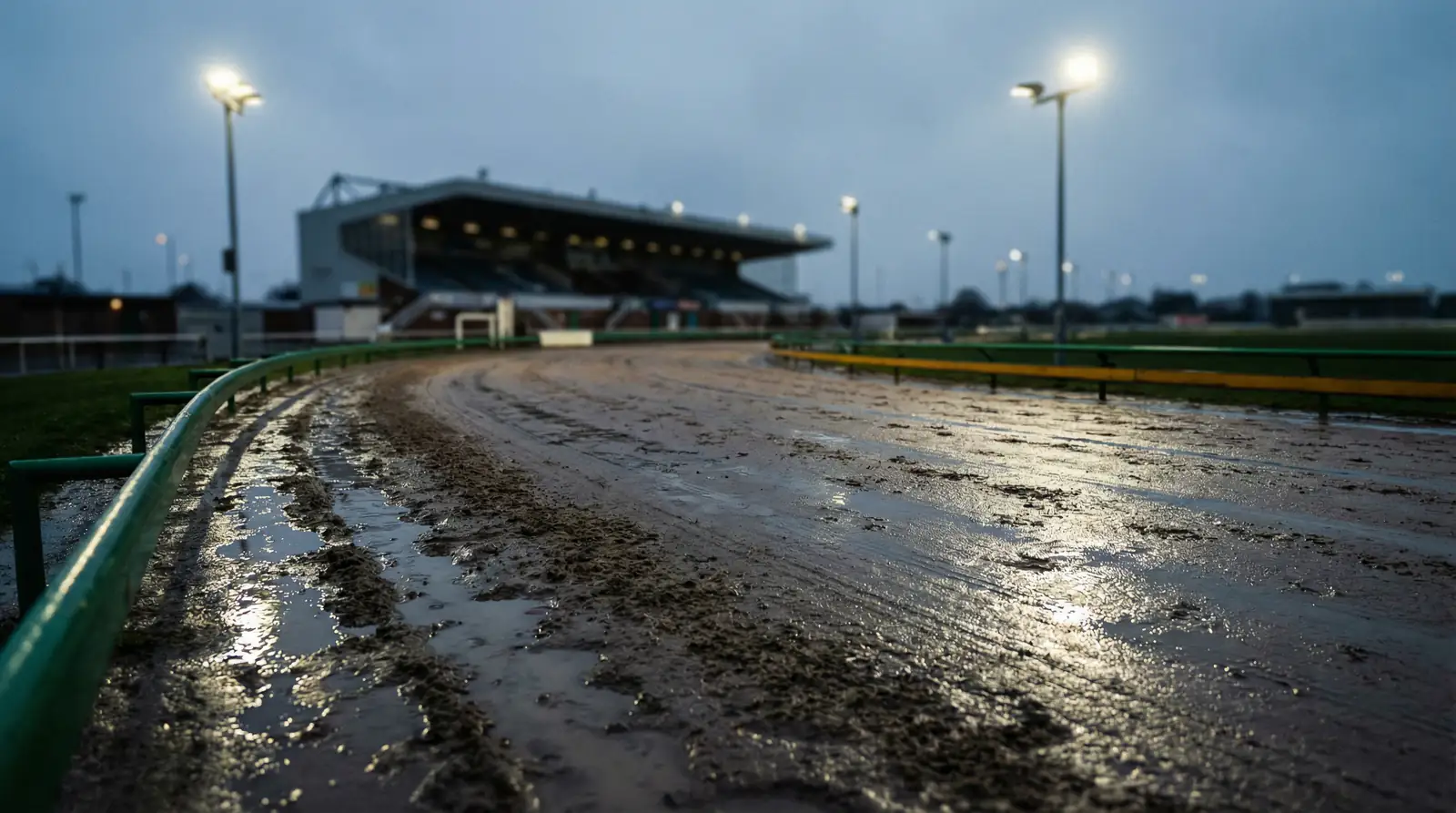
Rain is the most impactful weather variable. Wet sand behaves differently from dry sand — it compacts, becomes heavier, and changes the grip profile. Light rain often makes the surface marginally faster initially, as the moisture binds the top layer of sand and creates a firmer running surface. Sustained or heavy rain does the opposite: the sand becomes waterlogged, heavier, and slower. Times increase, and the physical demands on the dogs escalate.
The effect of rain isn’t uniform across the track width. Water tends to accumulate along the inside rail, where drainage is slower due to the track’s camber. Dogs running the rail in wet conditions may encounter a softer, heavier surface than dogs running a metre or two wide. This shifts the rail advantage that exists in dry conditions — the shorter distance of the inside line is offset by the heavier going. Wide runners, who cover more ground but run on a firmer part of the surface, can find themselves competing on more equal terms or even holding an advantage when conditions are wet.
Wind affects greyhound racing primarily through its interaction with the hare and with the dogs’ running lines in the straights. A strong headwind down the back straight slows the overall pace and can disproportionately affect front-runners, who are fully exposed to the wind without the partial shelter of other dogs. Tailwinds along the home straight can marginally benefit closers by assisting their finishing burst. These effects are real but smaller than rain, and they’re hardest to quantify because wind direction and strength change during a meeting.
Temperature influences the dogs more than the surface. Greyhounds are lean, muscular athletes with minimal body fat, and they’re sensitive to both cold and heat. In cold conditions, dogs may take longer to warm up, and early pace can suffer — particularly for dogs that haven’t had adequate kennel preparation. In warm conditions, the risk of overheating increases, and dogs racing multiple times on the same card may show declining performance in later races. UK greyhound racing rarely encounters extreme heat, but summer evening meetings in warm weather can produce slower times across the card as the meeting progresses.
Humidity interacts with the sand surface in less obvious ways. High humidity keeps the surface slightly moist even without rain, which can produce times somewhere between standard dry and wet conditions. Low humidity in cold winter weather can leave the surface loose and dusty, particularly at tracks that don’t irrigate between meetings.
Condition Form: Identifying Dogs That Handle the Going
Some greyhounds perform markedly better on specific surfaces and in specific conditions. This isn’t a universal rule — most dogs run competitively in all standard conditions — but at the margins, condition preference can be the difference between a win and a mid-pack finish.
The clearest indicator is historical performance in wet conditions versus dry. If a dog’s form on rain-affected cards shows a pattern of improved finishing positions — running second or third in dry conditions but winning when it’s wet — you’re looking at a dog that either handles the heavier surface better than its rivals or benefits from the tactical changes that wet conditions produce (slower pace, less bunching at the first bend, more space for wide runners).
Weight is a relevant factor. Heavier dogs carry more momentum, which can be advantageous on a soft, heavy surface where lighter dogs struggle for traction. Lighter dogs tend to excel on fast, dry surfaces where their quicker acceleration counts for more. This isn’t a definitive rule, but it’s a pattern that appears consistently enough in the data to be worth noting when assessing a field on a rain-affected card.
Running style interacts with conditions too. Front-runners that rely on explosive early pace are more affected by heavy going than closers, because the energy cost of leading on a heavy surface is higher and the pace advantage smaller. Closers benefit because the leaders slow down, reducing the ground they need to make up. On fast, dry surfaces, the pattern reverses: front-runners establish bigger early leads, and closers run out of straight before they can close the gap.
To use condition form effectively, you need access to historical race-day weather data for your selected tracks. Some data providers include track condition notes alongside results, which makes cross-referencing straightforward. Where this data isn’t available, checking weather records for the dates of previous runs gives you a workable proxy. It’s an extra step, but in a sport where margins are tight, the punters who take that step have information that most of the market doesn’t.
Conditions Are a Variable — Treat Them Like One
Track conditions don’t replace form analysis. They modify it. A dog with improving form on a fast surface doesn’t become a bad bet because it’s raining — but its advantage may be smaller, and the market may not have adjusted. A dog with mediocre recent form might be a stronger proposition if its best runs came in conditions similar to tonight’s meeting and the rest of the field are untested in the wet.
The practical habit is simple: check the weather before the meeting, note any significant rain or temperature extremes, and factor that into your assessment of each runner. It takes two minutes. The information it provides is available to everyone, but used by surprisingly few. That gap between availability and application is where value sits — in this case, almost literally beneath the surface.